
Health insurance without red demands
Negotiate the right tier, assign the right HR Manager and understand minimum billing.
Decision first
Buy insurance when enough employees require it or resignation and performance risk exceed the minimum-plan cost.
Health insurance is a negotiated headquarters benefit administered through an HR manager. It can satisfy an Important employee demand, but its economic value depends on tier, enrollment, the ten-person billing floor and the employee's complete satisfaction mix.
Use Build 3674 as the version boundary.
Complete operating playbook
- ARTICLE LENGTH
- 5,549 words
- DEEP-DIVE SECTIONS
- 15
- RESEARCH LEDGER
- 10
Health insurance in the Build 3674 employee system
Health insurance is a negotiated headquarters benefit administered through an HR manager. It can satisfy an Important employee demand, but its economic value depends on tier, enrollment, the ten-person billing floor and the employee's complete satisfaction mix.
The mechanic is not purchased from an ordinary shop and is not activated by merely hiring an HR manager. The manager needs a compatible headquarters workstation, a valid schedule and an active HR plan. The player visits the hospital, selects an eligible manager, waits for the offer or callback, negotiates the contract and accepts it. The resulting plan must then be associated with the intended employees through the HR structure. Developer guidance explicitly directs uncertain players to the F1 entry for HR Manager, which links the hospital and insurance help pages.
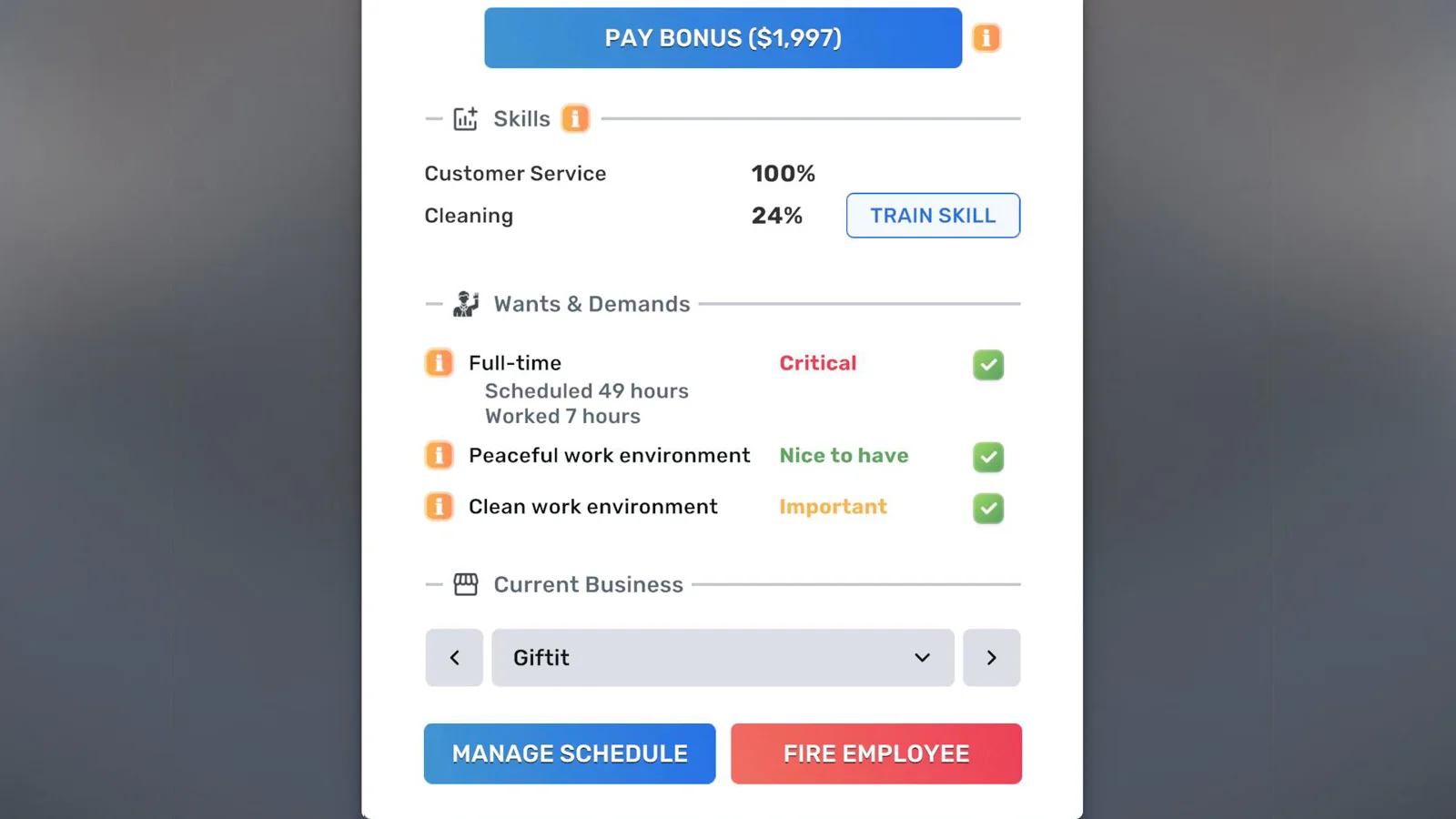
Insurance belongs in retention analysis rather than being treated as a universal productivity buff. A May 2026 developer reply characterizes the insurance demand as Important. The employee's FT/PT employment demand is generally Critical, and satisfying it may be enough to keep the net daily satisfaction trend positive when insurance is the only unmet lower-weight demand. That is not a promise for every employee: another Important demand or a severe schedule conflict can make the combined trend negative. Read the priorities and resulting trend together.
A plan's quoted per-person price is incomplete for a group smaller than ten. The corrected official behavior activates the policy but bills for at least ten people. This creates unused-premium cost and makes consolidation valuable. Tier choice adds another dimension: Gold satisfies Gold, Silver and Bronze demands; Silver satisfies Silver and Bronze. Higher coverage can simplify grouping but may overpay for many employees to satisfy one person's requirement. The practical task is to buy the least costly portfolio that keeps priority-weighted satisfaction and retention risk within policy.
Action checklist
- Use Build 3674 as the version boundary.
- Seat and schedule an eligible HR manager.
- Create the HR plan before requesting coverage.
- Read demand priority and daily satisfaction trend together.
- Apply the ten-person minimum to every cost comparison.
- Choose tiers as a portfolio rather than employee by employee.
| Mechanic | Current working rule | What not to assume |
|---|---|---|
| Demand weight | Insurance is Important in current developer guidance | Every unmet insurance demand causes immediate quitting |
| Minimum bill | At least ten covered-person charges | A four-person plan bills only four |
| Tier hierarchy | Gold covers all tiers; Silver covers Silver and Bronze | Each demand needs a separate exact-tier contract |
| Activation | Requires HR plan and hospital workflow | Hiring an HR manager activates insurance |
Version history and advice that must be rejected
Insurance changed soon after introduction, so early screenshots and undated guides often preserve a bug or an outdated demand threshold as if it were current design.
EA 0.2 introduced Bronze, Silver and Gold health insurance tied to HR management. The player had to visit the hospital, wait roughly a day for an offer and negotiate. An early implementation did not activate a plan when fewer than ten employees were enrolled. The official correction changed the outcome: a sub-ten plan can activate, but the company is billed for ten. Any guide that says 'coverage simply will not work until employee ten' describes that early defect and should be rejected for Build 3674.
The same correction adjusted when insurance demands appear and clarified that Gold can be locked when HR skill is insufficient. Therefore claims based on low-skill employees or managers in the launch state of EA 0.2 are not safe numeric references. Current interface locks, the plan quote and F1 help take precedence. If Gold is unavailable, develop or replace the HR manager and record the exact skill at which the interface changes; do not import an unversioned threshold from a wiki.
Build 3674 is the post-1.0 hotfix boundary. Its employee quit-state correction matters because stuck departures could block training and other headquarters systems, potentially making insurance administration appear frozen. Verify the build and advance a normal day before rebuilding all plans. The hotfix did not announce a new premium formula, demand weight or minimum, so those mechanics should be cross-checked against current UI and developer replies rather than invented from the build number.
Action checklist
- Reject the obsolete 'no activation below ten' claim.
- Preserve the current 'activate but bill ten' rule.
- Treat exact HR skill unlock thresholds as interface-tested values.
- Verify Build 3674 before diagnosing a stalled plan.
- Reject unversioned wiki numbers and SEO summaries.
| Legacy advice | Build 3674 treatment |
|---|---|
| Insurance cannot activate for nine employees | Reject; it activates but bills ten |
| Insurance demand appears at a fixed early skill percentage | Reject old threshold; read current employee detail |
| Gold is always available | Reject; manager skill can lock it |
| Any red insurance icon guarantees net satisfaction loss | Reject; evaluate weighted daily trend |
Prerequisite chain from headquarters to active contract
A reliable setup follows one dependency chain. Skipping a link produces the familiar hospital refusal, missing-manager list or inactive-plan symptom.
Select or create a headquarters with a free compatible office workstation. Recruit an HR manager through an office-role channel such as City Workforce, assign the worker to that headquarters and create a schedule that satisfies the manager's own employment band. Create an HR plan and select that manager. Add eligible employees within displayed capacity. Only then visit the hospital and begin the insurance request. If several headquarters exist, confirm the intended one is selected before recruiting or configuring.
At the hospital, select the HR manager for the desired plan request and let in-game time pass. Developer guidance describes a callback after a day or a couple of days depending on the discussion and update context; treat the current F1 text and actual offer timer as authoritative. Record request date and expected callback date. Repeated hospital visits before the timer completes do not repair a missing prerequisite and make it harder to know which action produced the offer.
After negotiating and accepting, verify three outcomes independently: the contract shows active, the correct HR group is attached, and each target employee displays coverage that satisfies the requested tier. Then observe the next satisfaction update. A green plan screen without changed employee status may indicate wrong group membership; a covered employee whose trend remains negative may have another demand problem. Do not use 'contract accepted' as the sole completion criterion.
Action checklist
- Confirm headquarters, desk, assignment and manager schedule.
- Create the HR plan and add target employees.
- Visit the hospital only after prerequisites are active.
- Record request and callback dates.
- Verify contract, group and employee status separately.
- Observe the next satisfaction tick.
| Link | Evidence to capture | Failure symptom |
|---|---|---|
| HQ workstation | Manager seated at compatible desk | Manager absent or nonfunctional |
| Schedule | Legal hours and manager working | Plan may not process as expected |
| HR plan | Manager selected and employees assigned | Hospital or enrollment options missing |
| Hospital request | Dated pending offer | Player expects immediate policy |
| Accepted contract | Tier, rate and active status | No coverage if acceptance incomplete |
| Employee receipt | Demand and satisfaction display | Wrong group or tier mismatch |
The ten-person minimum and effective unit cost
The billing floor is the central insurance calculation. Below ten enrolled employees, the effective cost per actual person rises sharply even though the displayed quote does not.
Let p be the negotiated price per billed employee and n be actual enrollees. The recurring charge is p × max(10,n). Effective cost per actual enrollee is p × max(10,n) ÷ n. Unused floor cost is p × max(0,10−n). If p is $120 and four workers enroll, the company pays $1,200, the effective cost is $300 per worker and $720 buys no additional covered employee. At ten, the same plan costs $1,200 or $120 each.
This formula changes hiring and grouping decisions. Adding a genuinely needed fifth through tenth employee to an already active small plan may carry zero incremental insurance bill, although wages and other costs remain. That does not justify hiring unnecessary workers: a zero marginal premium is not zero total labor cost. It does justify consolidating compatible employees under one manager and tier where capacity and demand permit. Two five-person Bronze groups at the same $120 quote cost $2,400; one ten-person group costs $1,200.
For more than ten employees, total premium scales normally, but tier fragmentation can recreate floors. A company with eleven Bronze employees and nine Gold employees might pay for eleven Bronze plus ten Gold. Moving a Bronze-requirement worker into Gold could reduce Bronze membership but not necessarily lower its bill, while the Gold plan may still be at its floor. Evaluate the whole portfolio after each move. A spreadsheet-like calculation can be maintained manually from quote, tier, actual count, billed count, total and unused-floor cost.
Action checklist
- Calculate billed count as max(10,n).
- Calculate effective cost from actual enrollees.
- Show unused-floor cost separately.
- Compare consolidation before opening another small plan.
- Never hire labor solely to use prepaid insurance capacity.
- Recalculate the entire tier portfolio after transfers.
| Actual n | Rate p | Billed | Total | Effective each | Unused-floor cost |
|---|---|---|---|---|---|
| 1 | $120 | 10 | $1,200 | $1,200 | $1,080 |
| 4 | $120 | 10 | $1,200 | $300 | $720 |
| 9 | $120 | 10 | $1,200 | $133.33 | $120 |
| 10 | $120 | 10 | $1,200 | $120 | $0 |
| 15 | $120 | 15 | $1,800 | $120 | $0 |
Tier hierarchy and portfolio grouping
Because stronger plans satisfy weaker requirements, tier selection is a grouping problem. The cheapest valid portfolio may mix plans, consolidate upward or temporarily leave a lower-weight demand unmet.
Developer guidance states that Gold coverage satisfies employees asking for Gold, Silver or Bronze, while Silver satisfies Silver or Bronze. Bronze only satisfies Bronze. This is a coverage hierarchy, not evidence that every employee gains extra satisfaction from a stronger plan. Assigning Gold to a Bronze-demand employee may solve administration but should be valued only as satisfying the demand unless the Build 3674 UI demonstrates another benefit.
Suppose eight employees require Bronze, six require Silver and two require Gold. Separate groups incur three ten-person floors: at illustrative rates of $80, $120 and $180, recurring cost is $800+$1,200+$1,800=$3,800. Consolidating Bronze and Silver into one Silver group gives fourteen people at $120=$1,680, while the two Gold workers still cost the ten-person minimum of $1,800, total $3,480. Putting all sixteen on Gold costs 16×$180=$2,880 and is cheaper in this artificial quote set despite overcoverage. Negotiated rates decide the answer.
Capacity and risk modify the result. The HR manager must be skilled enough for the tier and have room for the employees. A single high-tier group can concentrate dependency on one manager; two plans can provide organizational clarity even if slightly more expensive. Set a policy threshold: accept consolidation when recurring savings exceed added manager risk, transition work and any wage or training needed to unlock the tier. Document why each employee is in the group so later demand changes do not silently invalidate the design.
Action checklist
- Use Gold≥Silver≥Bronze as the satisfaction hierarchy.
- Do not assume overcoverage creates extra satisfaction.
- Compare separate, partial-consolidation and all-high-tier portfolios.
- Include ten-person floors in every scenario.
- Check manager skill and capacity.
- Document group membership rationale.
| Scenario | Calculation | Illustrative total |
|---|---|---|
| Three separate tiers | 10×80 + 10×120 + 10×180 | $3,800 |
| Bronze consolidated into Silver | 14×120 + 10×180 | $3,480 |
| All employees on Gold | 16×180 | $2,880 |
| Decision | Use negotiated Build 3674 quotes | Lowest valid total, adjusted for risk |
Demand priority and the decision to insure
Insurance should be purchased when its weighted retention benefit and operational-risk reduction exceed its full recurring cost. A red icon alone does not perform that comparison.
The current developer explanation identifies health insurance as Important. Employment type is Critical, so meeting FT/PT can offset one lower-weight miss and still produce positive satisfaction. Another Important demand can change the balance: two unmet Important items may outweigh one met Critical item according to earlier developer explanations of weighting. Observe the actual daily satisfaction arrow and change rather than counting green checks.
Prioritize by expected loss. Define expected departure cost = probability of departure during the decision horizon × replacement and disruption cost. Replacement cost includes recruiting fee, wage premium, training, lower initial output, manager time and uncovered shifts. Insurance value is the reduction in expected departure cost plus any avoided satisfaction recovery work. Buy when value exceeds recurring premium over the same horizon, subject to risk tolerance. For a key logistics manager, even a small probability reduction can justify an expensive floor; for an easily replaced low-volume cashier with positive trend, it may not.
Use a conservative escalation rule. Insure immediately when insurance is required and the employee's net trend is negative, the role has high cross-business consequence, or replacement lead time is long. Defer only when trend is safely positive, the role is redundant, and the expected plan cost is material. Review deferred cases weekly and after any newly revealed demand. This is risk management, not an instruction to deny every noncritical benefit.
Action checklist
- Record insurance priority and all other demands.
- Read the employee's net daily trend.
- Estimate departure consequence and replacement lead time.
- Compare avoided expected loss with full plan cost.
- Escalate critical cross-business roles.
- Review deliberate deferrals weekly.
| Condition | Default decision | Reason |
|---|---|---|
| Negative trend plus insurance unmet | Insure or fix stronger conflict immediately | Retention risk is active |
| Positive trend, redundant role, costly floor | May defer with weekly review | Benefit may not justify floor yet |
| Key HQ specialist with long replacement time | Bias toward insurance | Failure affects multiple businesses |
| Several compatible employees near a floor | Consolidate and insure | Effective unit cost falls |
Insurance and scheduling interactions
Insurance cannot compensate for a fundamentally invalid roster. Employment band and shift restrictions often carry equal or greater satisfaction weight and must be audited first.
Current scheduling practice uses 30–50 remembered weekly hours for full-time employees and 10–30 for part-time. Worked hours persist through the week and reset Monday, so a Wednesday schedule correction does not erase Monday and Tuesday. A full-time employee can remain red after a visible forty-hour future pattern because prior work pushes the remembered total over fifty. Buying insurance will satisfy an Important demand but will not repair the Critical employment-status breach.
Calculate required station-hours before assigning benefit groups. Example: a service desk operates 09:00–21:00 seven days, requiring one worker continuously: 84 station-hours. Staff FT-A Monday–Friday 09:00–17:00 for 40, FT-B Wednesday–Sunday 13:00–21:00 for 40, and PT-C Saturday–Sunday 09:00–13:00 for 8 would fail the usual part-time minimum. Add Monday 17:00–19:00 to PT-C for ten hours, but now inspect Monday overlap and evening demand. A better ten-hour residual may be Saturday/Sunday 09:00–14:00 if it closes the uncovered mornings exactly.
When comparing part-time and full-time benefit economics, calculate premium per staffed hour. A $120 plan with ten full-time workers at forty hours costs $0.30 per scheduled hour. Ten part-timers at ten hours cost $1.20 per scheduled hour. Part-timers may still be optimal for edge demand because they avoid idle wages, but the benefit allocation makes the tradeoff visible. Never conclude that one employment type is cheaper from hourly wage alone.
Action checklist
- Fix Critical employment-band violations before blaming insurance.
- Inspect remembered hours before midweek changes.
- Calculate station-hours and uncovered intervals.
- Ensure PT residual shifts meet the employee's band.
- Compare insurance cost per scheduled hour.
- Use demand evidence to justify part-time flexibility.
| Group | People | Hours each | Plan total | Premium per staffed hour |
|---|---|---|---|---|
| Full-time | 10 | 40 | $1,200 | $0.30 |
| Part-time | 10 | 20 | $1,200 | $0.60 |
| Edge part-time | 10 | 10 | $1,200 | $1.20 |
Worked insurance design for a growing company
A worked case demonstrates floors, hierarchy, manager capacity and satisfaction priority in one decision.
A company has thirty-four managed employees. Eighteen require Bronze, nine require Silver, three require Gold and four currently have no insurance demand. Negotiated illustrative monthly rates are $75 Bronze, $115 Silver and $175 Gold. Manager Alpha has skill sufficient for Gold and fifty capacity. Manager Beta is developing, has twenty displayed capacity and cannot offer Gold. All employees currently satisfy their Critical employment status; two Gold-demand specialists have negative trends because of additional Important demands.
Separate exact tiers cost 18×75=$1,350, max(10,9)×115=$1,150 and max(10,3)×175=$1,750, total $4,250. Consolidate Bronze and Silver into Silver: 27×115=$3,105 plus Gold floor $1,750, total $4,855, so exact tiers are cheaper. All thirty on Gold costs 30×175=$5,250. The four without demands should not be enrolled merely for symmetry unless plan administration or anticipated demand has a measured benefit.
Assign Gold and high-consequence specialists to Alpha, along with Bronze employees until group design and plan capacity are stable. Beta can administer the eighteen-person Bronze group if skill and tier allow, leaving Alpha's capacity for Silver, Gold and growth. Insure the three Gold employees now, but separately address the additional Important demands for the two negative-trend workers. Recalculate after the Silver group reaches ten or a new quote changes rates. The result is not 'always separate'; it is the lowest valid cost under these specific quotes and counts.
Action checklist
- List demand counts and negotiated rates.
- Calculate every tier with its own billing floor.
- Compare exact, consolidated and all-Gold cases.
- Respect manager skill and displayed capacity.
- Treat other negative-trend demands separately.
- Recalculate when group counts or quotes change.
| Portfolio | Bronze cost | Silver cost | Gold cost | Total |
|---|---|---|---|---|
| Exact tiers | 18×75=$1,350 | 10×115=$1,150 | 10×175=$1,750 | $4,250 |
| Bronze+Silver on Silver | — | 27×115=$3,105 | 10×175=$1,750 | $4,855 |
| All demanded workers on Gold | — | — | 30×175=$5,250 | $5,250 |
Negotiation and quote evaluation
A negotiated offer should be compared on total recurring cost and strategic fit, not accepted because its displayed per-person number looks lower than the last offer.
Record hospital, manager, tier, date, opening quote, accepted quote, group size and billing floor. Translate every quote immediately into recurring total using max(10,n). A ten-dollar reduction is worth $100 per billing period at the minimum and more with larger groups. The value of waiting or negotiating further is expected savings multiplied by the contract horizon, minus retention risk and delay cost. If a key employee is already declining, a slightly better quote tomorrow may be a false economy.
Compare like with like. A $100 Silver quote can be cheaper than an $85 Bronze quote if Silver consolidates enough Bronze and Silver employees to eliminate a second ten-person floor. Conversely, an attractive Gold per-person price may remain expensive when only two workers need it. Include any HR development or replacement cost required to unlock Gold. The quote is one input to portfolio optimization, not a tier-independent bargain.
Do not claim a universal negotiation percentage without a current controlled sample. Negotiation mechanics and difficulty can change, and candidate-style advice is often copied incorrectly into insurance guides. A reproducible sample uses the same build, difficulty and tier, records multiple opening and accepted offers, and reports distribution rather than one lucky result. Until such data exists, budget from the offered contract and treat further reductions as upside.
Action checklist
- Capture opening and accepted quotes.
- Convert per-person quote to total at the floor.
- Value delay against active retention risk.
- Compare tiers after consolidation effects.
- Include any HR skill-unlock cost.
- Reject universal negotiation percentages without versioned samples.
| Quote field | Why it matters |
|---|---|
| Tier | Defines which demands can be satisfied |
| Per-billed-person rate | Input, not total |
| Actual enrollment | Determines effective unit cost |
| Billed enrollment | At least ten |
| Offer date and delay | Measures retention exposure |
| HR manager and skill | Explains eligibility and reproducibility |
Diagnostics for missing, inactive or ineffective coverage
The symptom identifies where to test. Diagnose eligibility, timing, billing and employee outcome separately instead of repeatedly canceling contracts.
If no HR manager appears at the hospital, verify headquarters selection, compatible desk, business assignment, legal schedule and active HR plan. If the manager appears but Gold is locked, inspect manager skill. If the request succeeds but no offer arrives, record elapsed in-game days, advance normal time and inspect notifications; consult the Build 3674 F1 help. If the accepted plan is inactive, confirm enrollment and funding, then compare the next billing event.
If the bill is higher than enrolled count multiplied by the displayed rate, test the ten-person minimum first. For n<10, the higher total is expected, not duplicate billing. Record n, p, max(10,n) and actual charge. If n≥10 and the equation does not reconcile, inspect whether multiple plans or periods were charged and capture a full ledger. Avoid declaring a billing defect from a single rounded display.
If an employee still shows unmet insurance, compare required tier with received tier, plan ownership and next satisfaction tick. Bronze cannot satisfy Silver or Gold. If insurance turns green but satisfaction still falls, list every demand and priority, worked hours and schedule restriction. The plan may be working while another Important demand drives the negative result. For several headquarters systems failing together, verify Build 3674 and the fixed quit-transition state before mass reconfiguration.
Action checklist
- Missing manager: audit HQ, desk, schedule and active plan.
- Locked tier: record HR skill.
- No offer: track in-game callback delay.
- High bill: reconcile the ten-person floor and multiple plans.
- Unmet demand: compare required and received tier.
- Negative trend: inspect every demand and remembered hours.
| Symptom | Likely class | First evidence |
|---|---|---|
| Manager absent at hospital | Prerequisite | HQ assignment and active HR plan |
| Gold locked | Skill eligibility | Exact manager skill and UI lock |
| No callback | Timing or notification | Request date and elapsed days |
| Bill seems multiplied | Minimum or duplicate plan | n, p, billed count and plan list |
| Employee remains red | Tier or membership | Required versus received coverage |
| Employee declines despite green insurance | Other demands | Priority list and daily trend |
Accounting, cash-flow and renewal thresholds
Insurance is recurring overhead. A sustainable plan remains affordable during weak sales weeks and creates enough retention value to justify cash committed before the next revenue cycle.
Maintain a benefit reserve equal to at least the next known insurance charge plus payroll and other unavoidable obligations due before expected receipts. Do not fund a marginal Gold upgrade with cash required for wages or inventory. Forecast plan cash flow by billing date, not by average daily expense, because a technically profitable company can still miss a clustered payment. The game interface and save-specific billing cadence are authoritative; label any observed timing in the ledger.
Use incremental decision math. Upgrade cost = new portfolio recurring total minus current portfolio recurring total, plus one-time transition or manager-development costs. Expected benefit = reduced departure risk × replacement/disruption cost plus any measurable operating benefit. Adopt when expected benefit exceeds cost over the review horizon and minimum cash reserve remains intact. For a $900 recurring increase that reduces a key specialist's estimated 10% monthly departure risk to 2% where replacement/disruption would cost $15,000, expected avoided loss is 0.08×15,000=$1,200; net expected value is $300 before secondary effects.
Set review thresholds rather than constantly switching. Recalculate when headcount crosses ten in any tier, a mature demand appears, a manager approaches capacity, a quote changes, a key employee turns negative, or the cash reserve falls below policy. Frequent cancellation can introduce callback delays and retention gaps. Keep the current plan unless a new portfolio clears a meaningful savings threshold after transition risk.
Action checklist
- Reserve cash for the next premium and payroll.
- Forecast actual billing dates.
- Calculate incremental upgrade cost.
- Estimate avoided departure and disruption loss.
- Review at tier-count and risk thresholds.
- Avoid churn for trivial quoted savings.
| Decision input | Worked example |
|---|---|
| Recurring upgrade | $900 |
| Departure risk reduction | 10% to 2% = 8 points |
| Replacement/disruption loss | $15,000 |
| Expected avoided loss | $1,200 |
| Expected net before secondary effects | +$300 |
| Cash gate | Next premium, payroll and inventory still funded |
Tracking fields and audit evidence
A compact insurance register should reconcile contract, employee demand, HR capacity and cash. Without those links, a low quote can hide an expensive or ineffective plan.
Contract fields: plan identifier, tier, hospital, HR manager, manager skill, request date, callback date, activation date, quoted rate, negotiated rate, actual enrollment, billed enrollment, recurring total, unused-floor cost, billing date and status. Preserve screenshots of the offer and active plan after material changes. Never store only the per-person rate.
Employee fields: identifier, role, business, FT/PT status, worked weekly hours, insurance demand tier, priority, received tier, HR owner, satisfaction value and daily trend, other demands, replacement lead time and operational consequence. Review date is essential because developing employees can reveal new demands. Record deliberate noncoverage with reason and next review date so it is a controlled risk, not an omission.
Portfolio fields: total active employees, managed count, uninsured count, Bronze/Silver/Gold demand counts, each plan's displayed HR capacity, open slots, total premium, premium per scheduled labor-hour and expected retention loss avoided. Reconciliation equations are actual enrolled ≤ managed eligible employees and total contract cost = sum(rate × max(10,plan enrollment)). Investigate every difference before using the result for strategy.
Action checklist
- Keep contract, employee and portfolio registers linked.
- Store actual and billed enrollment separately.
- Record manager skill and displayed capacity.
- Capture other demands and satisfaction trend.
- Document deliberate noncoverage and review date.
- Reconcile every contract to the premium total.
| Register | Minimum fields |
|---|---|
| Contract | Tier, manager, dates, rate, actual/billed count, total, status |
| Employee | Demand/priority, received tier, plan owner, trend, other demands |
| Portfolio | Demand counts, capacity, total premium, floor waste, uninsured risk |
| Evidence | Build, difficulty, screenshot, F1 text or source URL |
Weekly benefit audit
A weekly rhythm aligns the Monday hour reset, plan membership changes and cash review. It catches problems before a satisfaction decline becomes a resignation.
On Monday, refresh employee worked-hour status after reset and separate schedule problems from insurance problems. Reconcile active employees with HR groups and coverage. Review anyone newly hired, returned from training, transferred or permanently replaced. Update tier demand counts and test whether crossing ten changes the optimal portfolio. Confirm each HR manager remains scheduled and within displayed capacity.
Midweek, process hospital callbacks, inspect daily satisfaction trends and verify newly accepted coverage at the employee level. Log sickness and permanent replacement events because they change the value of insurance and the plan's membership. Avoid a full schedule rewrite; employees remember hours already worked. If a declining employee needs immediate protection, fix the strongest conflict first and record the temporary cash impact.
On Friday, reconcile charges, floor waste and cash reserve. Compare quoted and actual bill, then forecast next period with pending hires and departures. Review deliberate noncoverage, manager skill progression and locked tiers. Approve changes for Monday unless the risk requires immediate action. After any game update affecting employees, HR, satisfaction or billing, rerun the smallest controlled test and attach the new build label.
Action checklist
- Monday: reconcile roster, hours, groups and tier demands.
- Midweek: process callbacks and verify employee receipt.
- Friday: reconcile charge, floor waste and reserve.
- Include pending hires and departures in the forecast.
- Schedule structural changes for Monday when possible.
- Retest after relevant patches.
| Time | Audit output |
|---|---|
| Monday | Clean employee-to-plan reconciliation and tier-count forecast |
| Daily exception | Callback, negative trend, missing coverage or replacement event |
| Friday | Charge reconciliation, reserve forecast and approved changes |
| Post-patch | Build-labelled activation, minimum and tier tests |
Common mistakes and precise corrections
Insurance failures usually come from stale activation advice, ignored minimum billing, excessive tier purchasing or trying to solve a schedule problem with benefits.
Mistake: waiting to reach ten because an old guide says coverage cannot activate. Correction: request the plan when justified; expect activation below ten but budget ten charges. Mistake: multiplying quote by actual small-group enrollment. Correction: use max(10,n). Mistake: opening separate plans for every tier without comparison. Correction: model exact, consolidated and all-higher-tier portfolios with negotiated rates.
Mistake: assuming Gold creates extra satisfaction for every Bronze employee. Correction: use hierarchy as demand satisfaction, not an unverified bonus. Mistake: purchasing insurance for a red full-time employee whose remembered hours exceed fifty. Correction: repair the Critical scheduling status and wait for Monday reset where necessary. Mistake: counting green boxes. Correction: use priorities and net daily trend.
Mistake: canceling a working contract because a callback did not arrive immediately. Correction: record the request and allow the F1-described delay. Mistake: blaming insurance when several headquarters plans freeze on an old launch build. Correction: update to Build 3674 and account for the quit-state fix. Mistake: relying on a universal negotiation discount from an unversioned post. Correction: budget the actual offer and collect a controlled sample before stating a range.
Action checklist
- Replace sub-ten activation myth with minimum-billing math.
- Model tier consolidation before accepting.
- Fix employment-band failures separately.
- Judge weighted trend, not green-box count.
- Track callback time before canceling.
- Reject unversioned negotiation and unlock numbers.
| Mistake | Correction |
|---|---|
| Wait for ten to activate | Activate when justified; bill still floors at ten |
| Quote × actual n below ten | Quote × max(10,n) |
| Exact tier for every demand | Compare hierarchy-based consolidation |
| Insurance used to fix FT/PT | Correct remembered weekly hours |
| One delayed callback called broken | Check prerequisites and elapsed game days |
| Unversioned discount treated as rule | Use current offer or versioned sample |
Build 3674 reproducible insurance tests
Tests should isolate activation, billing, hierarchy and satisfaction. Label every result so a future patch can be compared rather than argued from memory.
Activation test: on an unmodded disposable Build 3674 save, seat and schedule one eligible HR manager, create an active plan and request Bronze at the hospital. Record manager skill, request date, callback date and activation. Repeat with fewer than ten assigned employees. Expected current behavior is activation with billing for ten, not refusal. Capture F1 text and the offer screen.
Billing test: maintain groups of four, ten and eleven with the same tier and quote where a controlled save permits. Record actual enrollment, billed amount and billing period; compare with p×max(10,n). Hierarchy test: give a Bronze-demand employee Silver, and Bronze/Silver-demand employees Gold, then observe the demand state after the next update. Do not infer hierarchy only from the contract label.
Satisfaction test: choose employees with known demand sets. Hold schedule and all other demands constant, add adequate insurance and measure daily trend before and after. Repeat with an employee whose Critical employment demand is met but insurance is unmet to verify whether the net remains positive in that case. Do not generalize one employee's weighting to all profiles. Report build, difficulty, mods, employee skill, demands, priorities, hours, manager skill and exact observation times.
Action checklist
- Use an unmodded disposable save.
- Capture build, difficulty and F1 wording.
- Isolate one variable per test.
- Test fewer than ten, ten and more than ten.
- Observe employee demand state after tier changes.
- Report satisfaction profile rather than a universal weight formula.
| Test | Controlled variable | Expected Build 3674 observation |
|---|---|---|
| Sub-ten activation | Enrollment <10 | Active coverage, ten-person charge |
| Billing floor | n=4,10,11 | p×10, p×10, p×11 |
| Tier hierarchy | Received tier | Higher tier satisfies lower requirement |
| Satisfaction | Insurance present/absent | Profile-specific trend change |
| Gold eligibility | Manager skill | UI lock changes at observed threshold |
Research ledger
These links establish mechanics or provide a reproducible lead. Any balance-sensitive number still has to be checked in the current save.
Questions answered
Do I need ten employees before health insurance works?
No. The corrected official mechanic allows a plan below ten to activate, but the company is billed for ten people. Advice that says it simply stays inactive describes an early EA 0.2 defect.
How do I obtain a health-insurance plan?
Seat and schedule an HR manager in headquarters, create an active HR plan, visit the hospital, select the manager, wait for the offer or callback, negotiate and accept. Verify the group and each employee's received tier afterward.
Does Gold insurance satisfy Silver and Bronze demands?
Yes, according to developer guidance. Gold satisfies all three tiers, while Silver satisfies Silver and Bronze. Use negotiated total cost and billing floors to decide whether consolidation is economical.
Why does a four-person plan cost as if ten are covered?
Insurance has a ten-person minimum bill. At rate p and actual enrollment n, total is p×max(10,n). This is expected current behavior rather than duplicate enrollment.
Is health insurance a Critical employee demand?
A May 2026 developer reply describes it as Important. Employment status is generally Critical. Evaluate the employee's entire demand set and net daily satisfaction trend because multiple Important misses can change the result.
Why is Gold locked for my HR manager?
Higher-tier access can depend on HR skill. Record the manager's exact skill and the Build 3674 interface state, then develop or replace the manager. Do not rely on an unversioned exact unlock percentage.
Should I insure employees who do not currently demand it?
Not automatically. Overenrollment may be useful when it eliminates a separate floor or simplifies a portfolio, but there is no verified extra satisfaction benefit for unnecessary higher coverage. Compare full cost and risk.
What is the most important weekly insurance audit?
Reconcile active employees to HR plans and received tiers, apply the ten-person floor to each contract, inspect negative satisfaction trends, and forecast cash for the next bill. Monday is best for separating schedule status after the hour reset.