
Marketing without wasting cash
Buy only enough promotion to use profitable spare capacity.
Decision first
Stop increasing marketing when promotion reaches its cap or the store already fills its practical capacity.
Marketing contributes to promotion and can increase customer flow, but it does not create structural capacity.
Prove the store functions.
Complete operating playbook
- ARTICLE LENGTH
- 5,551 words
- DEEP-DIVE SECTIONS
- 16
- RESEARCH LEDGER
- 6
Marketing is a demand lever
Marketing contributes to promotion and can increase customer flow, but it does not create structural capacity.
Developer explanations distinguish promotion from the hard building and equipment ceiling.
Procedure: verify functioning trade; record traffic and promotion; measure spare capacity; select a campaign; compare incremental completed customers and profit
Example: A campaign attracts interest to a store whose only display supports ten customers. Completed sales remain capped, making the campaign cost pure leakage.
When marketing appears ineffective, inspect capacity, stock, staffing, hours, price, and satisfaction before escalating spend. Inspect promotion, effective capacity, hourly customers, campaign cost, and incremental contribution before choosing the more expensive branch.
Record baseline and campaign periods plus every operational control in BizMan. Use promotion, effective capacity, hourly customers, campaign cost, and incremental contribution only when its controls remain comparable.
Marketing is not a repair for a broken transaction path. Confirm the current F1 requirement again after a relevant patch.
Follow the cheap branch first: establish prove the store functions, read promotion, effective capacity, hourly customers, campaign cost, and incremental contribution, and commit to retain only positive lift only when both support the same explanation.
Write the campaign hypothesis operationally: which hours have spare capacity, which stocked products have demand, and how many additional customers cover cost. A higher promotion bar is not itself an objective.
Action checklist
- Prove the store functions.
- Measure unused capacity.
- Preview effectiveness.
- Test one campaign.
- Retain only positive lift.
| Checkpoint | Evidence of a pass | Response to failure |
|---|---|---|
| prove the store functions | promotion, effective capacity, hourly customers, campaign cost, and incremental contribution supports the intended condition under the recorded controls. | measure unused capacity |
| preview effectiveness | baseline and campaign periods plus every operational control is complete and the comparison has no unexplained outage. | test one campaign |
| retain only positive lift | The downside is affordable and a review trigger is recorded. | Pause and repeat the smallest disputed test in marketing is a demand lever. |
What official sources do and do not say
Official material confirms campaign effectiveness previews and multi-campaign purchasing, but does not publish a complete customer-response equation. The chosen target must remain serviceable through the next replenishment opportunity.
The developer says traffic and marketing combine into promotion and that multiple other factors determine actual customers.
Procedure: use displayed values; avoid reverse-engineered certainty; form a testable hypothesis; record controls; report results as observations
Example: An old post claims a precise conversion from traffic and marketing to promotion. Build 3674's live interface can be used, but the unsupported equation should not be presented as official.
If an external calculator disagrees with the game, trust the current interface and test outcome. Inspect displayed traffic, campaign effectiveness, promotion, and realized customers before choosing the more expensive branch.
Record exact UI values, build, date, business, neighborhood, and experiment result in BizMan. Use displayed traffic, campaign effectiveness, promotion, and realized customers only when its controls remain comparable.
Hidden coefficients can change without making every old explanation obviously false. Confirm the current F1 requirement again after a relevant patch.
Exclude contaminated comparisons. An uncovered shift, closure, stockout, supplier arrival, rival move, hype period, shortage, backorder, or game patch can change the result independently of label evidence type.
Copy displayed effectiveness and price for every campaign before selecting one. Official notes confirm the preview, but only a matched sales test reveals whether that reach converts profitably.
Action checklist
- Capture live UI values.
- Label evidence type.
- Reject unsupported formulas.
- Run direct tests.
- Publish conditions.
| Checkpoint | Evidence of a pass | Response to failure |
|---|---|---|
| capture live UI values | displayed traffic, campaign effectiveness, promotion, and realized customers supports the intended condition under the recorded controls. | label evidence type |
| reject unsupported formulas | exact UI values, build, date, business, neighborhood, and experiment result is complete and the comparison has no unexplained outage. | run direct tests |
| publish conditions | The downside is affordable and a review trigger is recorded. | Pause and repeat the smallest disputed test in what official sources do and do not say. |
Baseline before campaign
Incremental return cannot be measured without a comparable period in which the campaign is absent.
BizMan's hourly customers and EconoView costs provide the observations needed for a baseline.
Procedure: stabilize stock and staff; freeze prices and hours; run representative days; record customers and contribution; then begin one campaign
Example: Sales rise after advertising, but the baseline day had a two-hour stockout. The apparent lift overstates campaign value because availability changed.
Invalidate baselines containing closures, stockouts, schedule gaps, or major rival events. Inspect baseline hourly customers, transactions, contribution, capacity utilization, and anomalies before choosing the more expensive branch.
Record day and hour detail plus market snapshot and full cost categories in BizMan. Use baseline hourly customers, transactions, contribution, capacity utilization, and anomalies only when its controls remain comparable.
Weekday and weekend demand differ, so match like with like. Confirm the current F1 requirement again after a relevant patch.
Turn the observation into a trigger. Continue while baseline hourly customers, transactions, contribution, capacity utilization, and anomalies stays inside the chosen range, invoke capture matched baseline days at the boundary, and reconsider the larger plan only after exclude anomalies fails. Written triggers make repeated decisions consistent across in-game weeks.
Establish baseline days with identical prices, staff, hours, and stock. Discard a day containing stockout, closure, schedule gap, or major market event; otherwise advertising inherits improvement from repaired operations.
Action checklist
- Stabilize operations.
- Freeze other levers.
- Capture matched baseline days.
- Exclude anomalies.
- Start one campaign.
| Checkpoint | Evidence of a pass | Response to failure |
|---|---|---|
| stabilize operations | baseline hourly customers, transactions, contribution, capacity utilization, and anomalies supports the intended condition under the recorded controls. | freeze other levers |
| capture matched baseline days | day and hour detail plus market snapshot and full cost categories is complete and the comparison has no unexplained outage. | exclude anomalies |
| start one campaign | The downside is affordable and a review trigger is recorded. | Pause and repeat the smallest disputed test in baseline before campaign. |
Campaign effectiveness preview
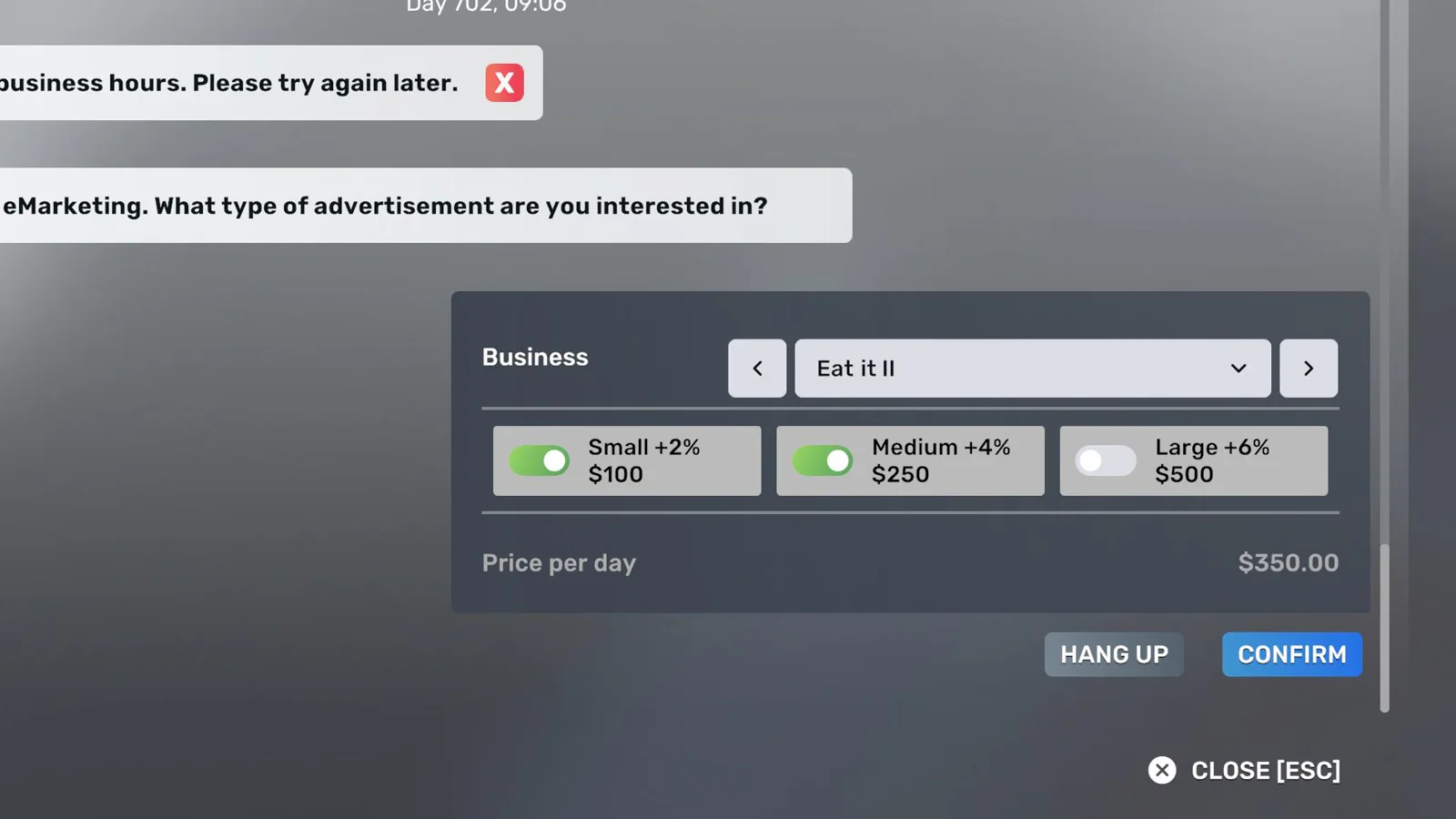
Since EA 0.11 the marketing interface shows how effective each marketing type is before purchase.
This official UI change allows comparison of campaign reach without buying every option blindly.
Procedure: open marketing for the intended business; record each preview; compare cost; estimate required lift; choose the smallest informative campaign
Example: A cheap campaign shows adequate effectiveness for a small site, while an expensive billboard mostly pushes promotion toward a ceiling. The preview helps avoid the oversized purchase.
If two campaigns overlap, compare marginal rather than total effectiveness. Inspect displayed effectiveness, cost, current promotion, and remaining capacity headroom before choosing the more expensive branch.
Record provider, campaign type, duration, displayed effect, daily cost, and selected combination in BizMan. Use displayed effectiveness, cost, current promotion, and remaining capacity headroom only when its controls remain comparable.
Displayed effectiveness does not guarantee completed customers because downstream constraints still apply. Confirm the current F1 requirement again after a relevant patch.
Compare a survival case with an upside case, keeping provider, campaign type, duration, displayed effect, daily cost, and selected combination explicit in both. The first asks whether the operation remains solvent after record every preview; the second asks whether avoid redundant overlap has room to add value. A plan that works only under upside assumptions is not ready.
Compare cost per displayed effectiveness point only for screening. Final choice depends on incremental contribution because a cheap point near capacity can be worth less than an expensive point during uncapped demand.
Action checklist
- Record every preview.
- Compare cost per effect.
- Check promotion headroom.
- Select the smallest test.
- Avoid redundant overlap.
| Checkpoint | Evidence of a pass | Response to failure |
|---|---|---|
| record every preview | displayed effectiveness, cost, current promotion, and remaining capacity headroom supports the intended condition under the recorded controls. | compare cost per effect |
| check promotion headroom | provider, campaign type, duration, displayed effect, daily cost, and selected combination is complete and the comparison has no unexplained outage. | select the smallest test |
| avoid redundant overlap | The downside is affordable and a review trigger is recorded. | Pause and repeat the smallest disputed test in campaign effectiveness preview. |
Traffic and marketing interaction
Natural traffic and purchased marketing both contribute to promotion, but traffic is attached to the property and marketing is a recurring cost. Keeping the sequence intact gives each change one plausible explanation.
Developer replies describe the combination qualitatively and warn against spending beyond useful customer potential.
Procedure: record natural traffic; record current promotion; measure actual flow; test incremental marketing; compare with relocation or capacity alternatives
Example: A low-traffic shop needs costly campaigns to approach the customer flow of a better address. The correct decision compares ongoing advertising with rent and moving cost.
If required campaign spending is permanent and large, revisit the site economics rather than assuming promotion must reach a round number. Inspect traffic, promotion, recurring campaign cost, customers, and property cost before choosing the more expensive branch.
Record current site and alternative site scenarios with matched capacity and demand assumptions in BizMan. Use traffic, promotion, recurring campaign cost, customers, and property cost only when its controls remain comparable.
Do not multiply traffic by capacity using an unverified formula. Confirm the current F1 requirement again after a relevant patch.
Resolve reversible uncertainty before irreversible cost. separate organic and paid flow can be tested for a short period, while a lease, broad fit-out, specialized hire, or large inventory position persists.
Treat traffic as a property characteristic and marketing as recurring rent on attention. When permanent spending offsets a weak address, compare its ongoing cost with relocation to stronger organic traffic.
Action checklist
- Separate organic and paid flow.
- Measure incremental lift.
- Price recurring spend.
- Compare relocation.
- Choose lower total cost.
| Checkpoint | Evidence of a pass | Response to failure |
|---|---|---|
| separate organic and paid flow | traffic, promotion, recurring campaign cost, customers, and property cost supports the intended condition under the recorded controls. | measure incremental lift |
| price recurring spend | current site and alternative site scenarios with matched capacity and demand assumptions is complete and the comparison has no unexplained outage. | compare relocation |
| choose lower total cost | The downside is affordable and a review trigger is recorded. | Pause and repeat the smallest disputed test in traffic and marketing interaction. |
Capacity saturation
Campaigns cannot increase completed customers during hours already capped by the building or the smallest required equipment category. Reconciliation decides whether the apparent gain survives all recorded costs.
The hard minimum-capacity rule and developer marketing warning directly establish this limit.
Procedure: calculate effective capacity; inspect Yesterday peaks; identify saturated hours; evaluate uncapped hours; pause or target spend accordingly
Example: A store is capped from noon to six but underused in the morning. An all-day campaign may add no peak sales while possibly helping mornings; hourly analysis is required.
When daily campaign results are flat, do not ignore hour-level saturation. Inspect hourly customers divided by effective capacity during campaign and baseline before choosing the more expensive branch.
Record saturated and unsaturated hours, spend allocation, customers, and contribution in BizMan. Use hourly customers divided by effective capacity during campaign and baseline only when its controls remain comparable.
Campaign controls may not allow perfect hour targeting, so judge the whole package economically. Confirm the current F1 requirement again after a relevant patch.
Audit every denominator. Write the denominator beside hourly customers divided by effective capacity during campaign and baseline; otherwise a changing scale can masquerade as improvement.
Split Yesterday into saturated and unsaturated hours. Advertising cannot add completed customers in the saturated block, so it must earn cost from remaining hours or a higher-value basket.
Action checklist
- Measure hourly saturation.
- Separate usable hours.
- Estimate possible lift.
- Compare package cost.
- Stop wasteful spend.
| Checkpoint | Evidence of a pass | Response to failure |
|---|---|---|
| measure hourly saturation | hourly customers divided by effective capacity during campaign and baseline supports the intended condition under the recorded controls. | separate usable hours |
| estimate possible lift | saturated and unsaturated hours, spend allocation, customers, and contribution is complete and the comparison has no unexplained outage. | compare package cost |
| stop wasteful spend | The downside is affordable and a review trigger is recorded. | Pause and repeat the smallest disputed test in capacity saturation. |
Demand and competition prerequisite
Marketing cannot manufacture local product demand or erase the effect of many competing providers. The ordered branches make the first failing transaction step visible.
The developer includes demand and competition in realized customer volume, while Market Insider exposes both.
Procedure: verify neighborhood; capture product demand; count providers; identify the stocked basket; advertise only after the opportunity is credible
Example: A heavily advertised store sells a saturated product with weak local demand. A campaign may redistribute a small market but cannot guarantee enough profitable buyers.
If promotion is high and customers remain low, inspect demand, product access, and provider count. Inspect demand by stocked SKU, providers, promotion, customers, and contribution before choosing the more expensive branch.
Record pre- and post-campaign Market Insider snapshots with products actually available in BizMan. Use demand by stocked SKU, providers, promotion, customers, and contribution only when its controls remain comparable.
Hype and shortage can temporarily alter demand, contaminating long campaign comparisons. Confirm the current F1 requirement again after a relevant patch.
Keep exception notes instead of smoothing them away. A stockout or rival action may invalidate an average yet expose weakness in audit the stocked basket.
Verify demand for products physically stocked, not merely the business category. High promotion aimed at a weak or crowded basket may redistribute too few buyers to cover acquisition and campaign costs.
Action checklist
- Verify the district.
- Audit the stocked basket.
- Count competitors.
- Mark market events.
- Test only viable demand.
| Checkpoint | Evidence of a pass | Response to failure |
|---|---|---|
| verify the district | demand by stocked SKU, providers, promotion, customers, and contribution supports the intended condition under the recorded controls. | audit the stocked basket |
| count competitors | pre- and post-campaign Market Insider snapshots with products actually available is complete and the comparison has no unexplained outage. | mark market events |
| test only viable demand | The downside is affordable and a review trigger is recorded. | Pause and repeat the smallest disputed test in demand and competition prerequisite. |
Pricing and conversion prerequisite
More arrivals do not create more sales when customers reject the price.
District-sensitive price tolerance and satisfaction influence realized customers and completed purchases.
Procedure: stabilize prices; record pricing satisfaction; run baseline; begin campaign; compare arrivals, customers, units, and complaints
Example: Promotion increases footfall while transactions remain flat because the hero item is overpriced. Lowering that one price may outperform buying another campaign.
If campaign traffic rises without proportional sales, inspect conversion blockers including price, queues, and stock. Inspect pricing satisfaction, arrivals or customers, units per customer, and campaign contribution before choosing the more expensive branch.
Record prices, complaints, basket size, completed transactions, and capacity state in BizMan. Use pricing satisfaction, arrivals or customers, units per customer, and campaign contribution only when its controls remain comparable.
The game may not expose every arrival separately, so use available complaint and sales evidence cautiously. Confirm the current F1 requirement again after a relevant patch.
Test reproducibility from the record alone. If prices, complaints, basket size, completed transactions, and capacity state omits the neighborhood, hours, stock state, staffing, price, or costs needed to recreate the observation, add the missing field. More decimal places cannot compensate for missing operating conditions.
If customers rise but units do not, inspect pricing complaints, queues, baskets, bags, and empty displays. This indicates conversion trouble; buying more reach exposes additional customers to the same failure.
Action checklist
- Stabilize price.
- Inspect satisfaction.
- Test campaign conversion.
- Repair the named blocker.
- Remeasure.
| Checkpoint | Evidence of a pass | Response to failure |
|---|---|---|
| stabilize price | pricing satisfaction, arrivals or customers, units per customer, and campaign contribution supports the intended condition under the recorded controls. | inspect satisfaction |
| test campaign conversion | prices, complaints, basket size, completed transactions, and capacity state is complete and the comparison has no unexplained outage. | repair the named blocker |
| remeasure | The downside is affordable and a review trigger is recorded. | Pause and repeat the smallest disputed test in pricing and conversion prerequisite. |
Stock and supply prerequisite
Advertising an understocked store accelerates stockouts and can lower measured return despite higher customer interest. The remaining uncertainty should appear in the record attached to units sold by SKU, stock coverage days, stockout hours, and urgent-order cost.
The official supply system uses weekly inbound orders, daily logistics, unit targets, and finite storage.
Procedure: forecast campaign demand; increase only critical buffers; verify receiving capacity; monitor SKU depletion; stop spend if primary stock becomes unavailable
Example: A campaign lifts a bestseller on Tuesday, but the next normal inbound order is Monday. Lost sales and urgent delivery cost consume the advertising gain.
When campaign profit disappoints, inspect stockout hours and emergency purchasing. Inspect units sold by SKU, stock coverage days, stockout hours, and urgent-order cost before choosing the more expensive branch.
Record opening stock, target, deliveries, campaign dates, depletion, and unavailable periods in BizMan. Use units sold by SKU, stock coverage days, stockout hours, and urgent-order cost only when its controls remain comparable.
Hype or shortage can make forecast error larger; avoid false precision. Confirm the current F1 requirement again after a relevant patch.
Apply forecast stock needs, observe units sold by SKU, stock coverage days, stockout hours, and urgent-order cost, and reverse the change when its predicted mechanism does not appear. Scaling a weak signal multiplies uncertainty and cost together.
Forecast campaign stock as baseline units plus expected incremental units and a named safety amount. Include the next supplier date because urgent replenishment can consume the advertisement's margin.
Action checklist
- Forecast stock needs.
- Protect bestseller buffers.
- Leave receiving space.
- Monitor depletion daily.
- Pause ads during stockouts.
| Checkpoint | Evidence of a pass | Response to failure |
|---|---|---|
| forecast stock needs | units sold by SKU, stock coverage days, stockout hours, and urgent-order cost supports the intended condition under the recorded controls. | protect bestseller buffers |
| leave receiving space | opening stock, target, deliveries, campaign dates, depletion, and unavailable periods is complete and the comparison has no unexplained outage. | monitor depletion daily |
| pause ads during stockouts | The downside is affordable and a review trigger is recorded. | Pause and repeat the smallest disputed test in stock and supply prerequisite. |
Marketing return formula
Campaign evaluation requires incremental contribution rather than total revenue during the advertised period.
EconoView costs and BizMan sales allow the calculation even though the game does not provide a universal marketing-response coefficient.
Procedure: calculate baseline contribution; calculate campaign-period contribution; adjust for matched conditions; subtract campaign cost; repeat
Example: A campaign adds twenty customers with average contribution eight, creating one hundred sixty before advertising cost. At two hundred daily cost, the test loses forty.
If average contribution changes because basket mix or price changed, calculate at SKU level. Inspect incremental customers, contribution per customer, campaign cost, and incremental profit before choosing the more expensive branch.
Record baseline and test contribution with exact cost and anomalies in BizMan. Use incremental customers, contribution per customer, campaign cost, and incremental profit only when its controls remain comparable.
Correlation is weaker when market events or schedule changes occur. Confirm the current F1 requirement again after a relevant patch.
End with a pre-mortem. Assume the choice failed, then rank measure added customers, subtract campaign cost, and repeat matched tests by how quickly each would explain the loss.
Compute incremental profit from campaign contribution minus matched baseline contribution minus campaign cost. When basket mix changes, calculate contribution by SKU rather than multiplying customers by an outdated average.
Action checklist
- Calculate baseline contribution.
- Measure added customers.
- Subtract campaign cost.
- Repeat matched tests.
- Keep only reproducible gains.
| Checkpoint | Evidence of a pass | Response to failure |
|---|---|---|
| calculate baseline contribution | incremental customers, contribution per customer, campaign cost, and incremental profit supports the intended condition under the recorded controls. | measure added customers |
| subtract campaign cost | baseline and test contribution with exact cost and anomalies is complete and the comparison has no unexplained outage. | repeat matched tests |
| keep only reproducible gains | The downside is affordable and a review trigger is recorded. | Pause and repeat the smallest disputed test in marketing return formula. |
Campaign portfolio and diminishing value
Multiple campaigns can be purchased together, but additional reach can have declining economic value near promotion, demand, or capacity limits. That distinction determines which screen can verify campaign portfolio and diminishing value.
EA 0.11 made multi-campaign purchasing easier without claiming every combination is optimal.
Procedure: rank campaigns by cost and displayed effect; add the first; recheck remaining headroom; add a second only with a marginal case; audit the bundle
Example: Campaign A produces most of the available lift. Campaign B raises the displayed percentage but cannot add completed customers during capped hours, so the bundle is worse.
When a portfolio underperforms, remove the campaign with the weakest marginal contribution rather than canceling all evidence. Inspect marginal effectiveness, marginal customers, marginal contribution, and total spend before choosing the more expensive branch.
Record order campaigns were added, effect after each, cost after each, and business result in BizMan. Use marginal effectiveness, marginal customers, marginal contribution, and total spend only when its controls remain comparable.
Simultaneous launch prevents clean attribution; stage additions when practical. Confirm the current F1 requirement again after a relevant patch.
Try to disprove the working assumption before funding it. For Campaign portfolio and diminishing value, hold marginal effectiveness, marginal customers, marginal contribution, and total spend steady while testing rank campaign options. If the predicted signal does not move, return to add one at a time and record the contradiction instead of adding another purchase to save the theory.
Add campaigns sequentially and record promotion after each. The second campaign must justify its own marginal cost; sales growth credited to the bundle cannot prove every component deserves renewal.
Action checklist
- Rank campaign options.
- Add one at a time.
- Recompute headroom.
- Measure marginal ROI.
- Remove redundant spend.
| Checkpoint | Evidence of a pass | Response to failure |
|---|---|---|
| rank campaign options | marginal effectiveness, marginal customers, marginal contribution, and total spend supports the intended condition under the recorded controls. | add one at a time |
| recompute headroom | order campaigns were added, effect after each, cost after each, and business result is complete and the comparison has no unexplained outage. | measure marginal ROI |
| remove redundant spend | The downside is affordable and a review trigger is recorded. | Pause and repeat the smallest disputed test in campaign portfolio and diminishing value. |
Hours and day weighting
Marketing value changes by hour and weekday because underlying customer patterns and capacity utilization change. The next decision should therefore be tied to hourly customers, day type, capacity utilization, staff cost, and campaign-period contribution, not to visual activity.
The developer recommends the Yesterday graph, and version-labelled 1.0 testing reports distinct hourly and day patterns by business type.
Procedure: build an hourly baseline; mark capacity saturation; align campaign periods where possible; compare same weekdays; calculate contribution by hour
Example: Weekend promotion benefits a nightclub more than a quiet weekday test, while a daytime service may show the reverse. A weekly average can hide both.
If a campaign seems inconsistent, disaggregate by day and hour before rejecting the mechanic. Inspect hourly customers, day type, capacity utilization, staff cost, and campaign-period contribution before choosing the more expensive branch.
Record a day-hour matrix linked to campaign status and anomalies in BizMan. Use hourly customers, day type, capacity utilization, staff cost, and campaign-period contribution only when its controls remain comparable.
The community heatmap supplies priors, not guaranteed store-specific traffic. Confirm the current F1 requirement again after a relevant patch.
Build a two-column ledger. Put hourly customers, day type, capacity utilization, staff cost, and campaign-period contribution under results and a day-hour matrix linked to campaign status and anomalies under controls. Credit capture hourly baseline only when the controls describe the same operating conditions; otherwise a delivery, staffing change, or unusually busy day can receive credit for an effect it did not cause.
Match weekdays and hours during evaluation. Weekend nightlife, evening food, or quiet service periods can dominate results, so an all-week average may assign normal time weighting to advertising.
Action checklist
- Capture hourly baseline.
- Match weekdays.
- Mark capped hours.
- Calculate hourly contribution.
- Target useful periods.
| Checkpoint | Evidence of a pass | Response to failure |
|---|---|---|
| capture hourly baseline | hourly customers, day type, capacity utilization, staff cost, and campaign-period contribution supports the intended condition under the recorded controls. | match weekdays |
| mark capped hours | a day-hour matrix linked to campaign status and anomalies is complete and the comparison has no unexplained outage. | calculate hourly contribution |
| target useful periods | The downside is affordable and a review trigger is recorded. | Pause and repeat the smallest disputed test in hours and day weighting. |
New-store awareness versus diagnosis
A new shop may justify a small awareness test, but full spending before operational proof confounds launch learning. Treat the live requirement as the gate for new-store awareness versus diagnosis.
Marketing can help below potential, yet every downstream requirement must still convert the additional interest.
Procedure: open with a stable minimum setup; collect no-ad data; fix functional complaints; test a modest campaign; scale only after positive incremental profit
Example: A new shop doubles spend on day one and receives low sales. It cannot distinguish weak demand, poor hours, missing capacity, or ineffective advertising.
When launch evidence is mixed, return to a clean baseline rather than stacking campaigns. Inspect pre-campaign functioning, spare capacity, baseline customers, and incremental lift before choosing the more expensive branch.
Record launch-day anomalies separately from mature campaign tests in BizMan. Use pre-campaign functioning, spare capacity, baseline customers, and incremental lift only when its controls remain comparable.
A small campaign can be strategically reasonable, but label it as a hypothesis rather than a requirement. Confirm the current F1 requirement again after a relevant patch.
Set a stopping rule before the experiment. Redesign the plan when pre-campaign functioning, spare capacity, baseline customers, and incremental lift remains unfavorable after prove basic conversion and collect baseline data both pass.
For a new store, first prove checkout, stock, staffing, price, and fixtures. A modest awareness test follows; maximum opening-day spending makes weak demand indistinguishable from operational failure.
Action checklist
- Prove basic conversion.
- Collect baseline data.
- Fix launch defects.
- Test modest awareness.
- Scale from evidence.
| Checkpoint | Evidence of a pass | Response to failure |
|---|---|---|
| prove basic conversion | pre-campaign functioning, spare capacity, baseline customers, and incremental lift supports the intended condition under the recorded controls. | collect baseline data |
| fix launch defects | launch-day anomalies separately from mature campaign tests is complete and the comparison has no unexplained outage. | test modest awareness |
| scale from evidence | The downside is affordable and a review trigger is recorded. | Pause and repeat the smallest disputed test in new-store awareness versus diagnosis. |
Marketing diagnostic decision tree
The correct marketing diagnosis begins with transaction readiness and ends with incremental economics. This turns marketing diagnostic decision tree into a measurable commitment rather than a guess.
Developer guidance establishes both capacity saturation and multi-factor customer flow.
Procedure: verify open and complete; verify stock and staff; verify spare capacity; verify demand and price; preview campaign; test ROI
Example: High promotion with low sales routes the player toward demand, price, satisfaction, hours, or product availability, not automatically toward more promotion.
Stop at the earliest failed condition and repair it before evaluating the next. Inspect first failed node in the marketing conversion chain before choosing the more expensive branch.
Record node result, supporting screen, action, cost, and comparable retest in BizMan. Use first failed node in the marketing conversion chain only when its controls remain comparable.
Sequential bottlenecks may appear after the first repair. Confirm the current F1 requirement again after a relevant patch.
Cross-check the management screens. BizMan should explain first failed node in the marketing conversion chain, while Market Insider or EconoView supplies the market or cost context contained in node result, supporting screen, action, cost, and comparable retest.
The decision tree checks open status, equipment, employees, inventory, spare capacity, demand, price acceptance, displayed effectiveness, and incremental profit. Stop at the first failed prerequisite.
Action checklist
- Test transaction readiness.
- Test capacity headroom.
- Test market viability.
- Run one campaign.
- Audit incremental profit.
| Checkpoint | Evidence of a pass | Response to failure |
|---|---|---|
| test transaction readiness | first failed node in the marketing conversion chain supports the intended condition under the recorded controls. | test capacity headroom |
| test market viability | node result, supporting screen, action, cost, and comparable retest is complete and the comparison has no unexplained outage. | run one campaign |
| audit incremental profit | The downside is affordable and a review trigger is recorded. | Pause and repeat the smallest disputed test in marketing diagnostic decision tree. |
Claims and formulas to reject
Universal instructions to reach a round promotion percentage or buy a particular billboard ignore capacity, demand, cost, and site differences. The dated observation becomes the baseline for claim provenance and controlled replication result.
Official sources describe relationships and UI previews but do not guarantee a fixed traffic-to-sales multiplier.
Procedure: date the claim; identify version and conditions; compare live UI; reproduce a small test; retain only the transferable method
Example: A guide says every large store needs maximum promotion. A particular store already hits its effective cap for most valuable hours, making the prescription wasteful.
If a claim cannot state baseline, campaign, capacity, stock, hours, and result, it is not reproducible evidence. Inspect claim provenance and controlled replication result before choosing the more expensive branch.
Record source, date, build, conditions, predicted effect, observed effect, and uncertainty in BizMan. Use claim provenance and controlled replication result only when its controls remain comparable.
Even a current test can become stale after balance patches. Confirm the current F1 requirement again after a relevant patch.
Ask a counterfactual question: if audit source provenance were not the constraint, what different result should appear in claim provenance and controlled replication result? A useful intervention produces distinguishable success and failure signals.
Reject advice prescribing one billboard package or universal promotion target. Reproducible evidence discloses build, business, neighborhood, traffic, capacity, hours, stock, prices, campaign, baseline, and cost-adjusted outcome.
Action checklist
- Audit source provenance.
- Compare conditions.
- Run a small replication.
- Measure economics.
- Flag uncertainty.
| Checkpoint | Evidence of a pass | Response to failure |
|---|---|---|
| audit source provenance | claim provenance and controlled replication result supports the intended condition under the recorded controls. | compare conditions |
| run a small replication | source, date, build, conditions, predicted effect, observed effect, and uncertainty is complete and the comparison has no unexplained outage. | measure economics |
| flag uncertainty | The downside is affordable and a review trigger is recorded. | Pause and repeat the smallest disputed test in claims and formulas to reject. |
Final marketing audit
A defensible campaign has a stable baseline, available demand, spare capacity, reliable conversion, enough stock, and positive incremental contribution.
This standard integrates the confirmed marketing relationship with the game's operational and financial constraints.
Procedure: verify baseline; verify market and capacity; verify pricing and stock; calculate incremental profit; schedule re-evaluation
Example: A low-cost campaign with modest visible effect can be superior to a prestigious billboard when both reach the same profitable customer ceiling.
Any unexplained difference in hours, staffing, price, stock, rivals, or market events weakens attribution. Inspect repeatable incremental profit with all prerequisites passing before choosing the more expensive branch.
Record campaign decision sheet, evidence window, controls, result, and stop trigger in BizMan. Use repeatable incremental profit with all prerequisites passing only when its controls remain comparable.
Re-audit after relocation, assortment change, capacity expansion, price changes, rival actions, or patches. Confirm the current F1 requirement again after a relevant patch.
Price the opportunity cost. Cash or time committed to confirm all prerequisites cannot also fund remove weak spend.
Renew marketing only after positive incremental contribution and when no cheaper bottleneck remains. Record a cancellation trigger tied to saturation, stock risk, demand loss, or declining marginal return.
Action checklist
- Confirm all prerequisites.
- Reconcile campaign costs.
- Calculate incremental profit.
- Remove weak spend.
- Set review triggers.
| Checkpoint | Evidence of a pass | Response to failure |
|---|---|---|
| confirm all prerequisites | repeatable incremental profit with all prerequisites passing supports the intended condition under the recorded controls. | reconcile campaign costs |
| calculate incremental profit | campaign decision sheet, evidence window, controls, result, and stop trigger is complete and the comparison has no unexplained outage. | remove weak spend |
| set review triggers | The downside is affordable and a review trigger is recorded. | Pause and repeat the smallest disputed test in final marketing audit. |
Research ledger
These links establish mechanics or provide a reproducible lead. Any balance-sensitive number still has to be checked in the current save.
Questions answered
Does marketing increase customer capacity?
No. It can contribute to customer flow through promotion, but the building limit and lowest relevant equipment capacity remain hard structural ceilings.
What promotion percentage should I target?
There is no verified universal target. Use the live effectiveness preview and test incremental contribution. Spending toward a round number is wasteful when demand, conversion, or capacity is already exhausted.
Why did a campaign produce no extra sales?
Check whether the store was at capacity, out of stock, understaffed, open at weak hours, overpriced, poorly rated, or serving low local demand. Marketing cannot repair those downstream constraints.
How do I calculate marketing ROI?
Compare matched baseline and campaign periods. A practical calculation is added completed customers multiplied by average contribution per customer, minus campaign cost. Use SKU-level contribution when the basket mix changes.
Should I launch several campaigns at once?
The interface permits it, but staged tests provide better evidence. Add campaigns sequentially when practical, remeasure remaining headroom, and keep only those with positive marginal contribution.