
Choosing a starter business
Match a simple supply path to the strongest demand in your save.
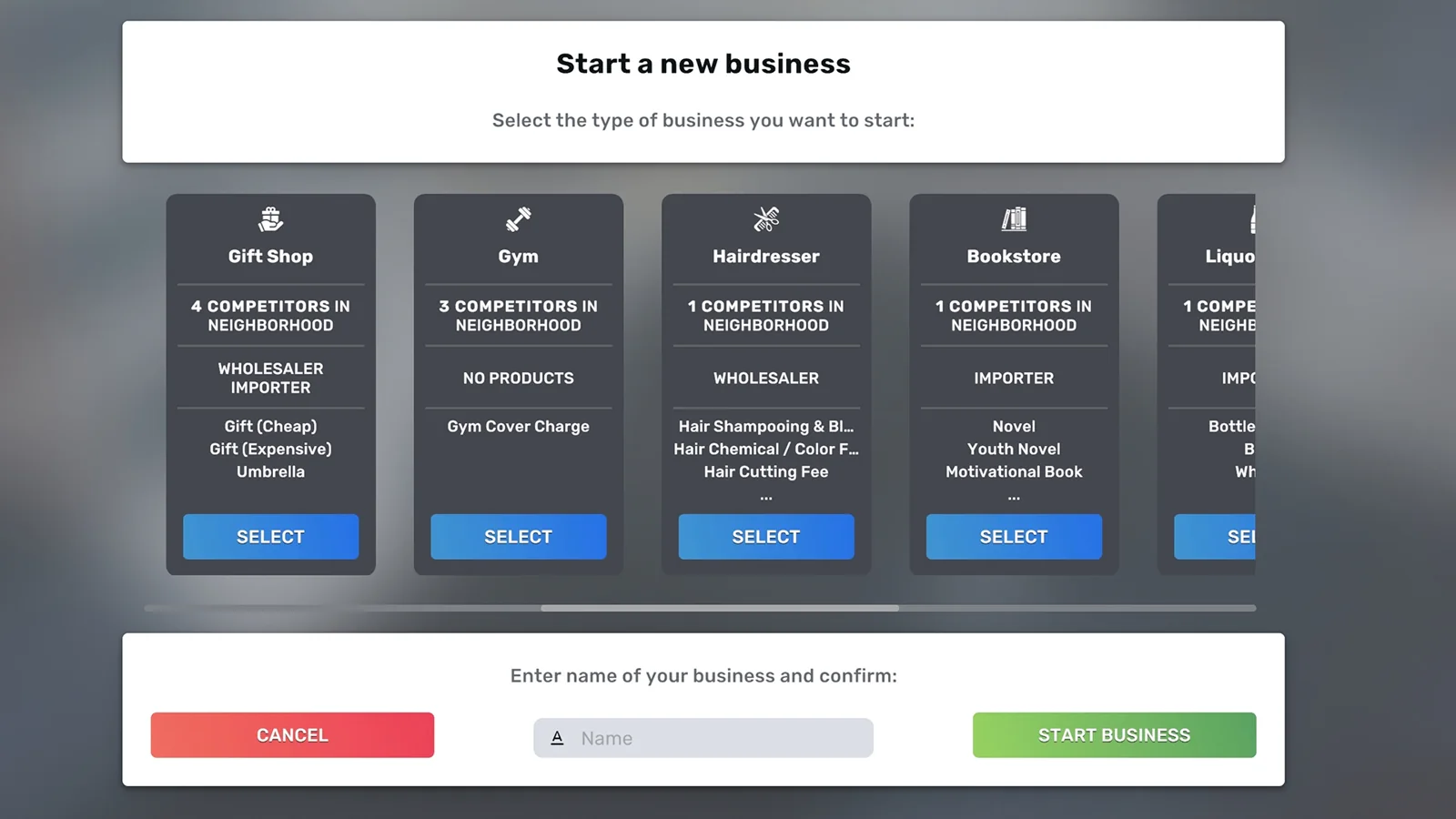
Decision first
Gift Shop, Florist and Fruit & Vegetable Store are safe defaults, but live neighborhood demand remains the final check.
No official source identifies one business as the most profitable starter across all saves, neighborhoods, and difficulties.
State the objective.
Complete operating playbook
- ARTICLE LENGTH
- 5,292 words
- DEEP-DIVE SECTIONS
- 14
- RESEARCH LEDGER
- 5
Reject the universal winner premise
No official source identifies one business as the most profitable starter across all saves, neighborhoods, and difficulties.
The verified mechanics make profit conditional on local demand, competition, product access, capacity, pricing, hours, staffing, and cost.
Procedure: define the player's objective; restrict choices by source access; compare local baskets; cost complete setups; run a conservative scenario
Example: A creator's gift shop succeeds in one district while the new save has saturated gifts and strong flowers. Copying the label instead of the conditions imports the wrong conclusion.
When advice names a winner without version, district, difficulty, prices, hours, and sourcing, treat it as anecdote. Inspect evidence completeness for every candidate before choosing the more expensive branch.
Record candidate conditions and the reason each external claim was accepted or rejected in BizMan. Use evidence completeness for every candidate only when its controls remain comparable.
Balance updates and dynamic rivals make even honest historical rankings perishable. Confirm the current F1 requirement again after a relevant patch.
Follow the cheap branch first: establish state the objective, read evidence completeness for every candidate, and commit to reject unconditioned rankings only when both support the same explanation.
Require every claimed starter winner to disclose build, neighborhood, difficulty, building limit, hours, staff skill, prices, source route, and profit definition. Missing fields turn a result into inspiration rather than transferable evidence.
Action checklist
- State the objective.
- Filter by access.
- Capture current demand.
- Cost full operation.
- Reject unconditioned rankings.
| Checkpoint | Evidence of a pass | Response to failure |
|---|---|---|
| state the objective | evidence completeness for every candidate supports the intended condition under the recorded controls. | filter by access |
| capture current demand | candidate conditions and the reason each external claim was accepted or rejected is complete and the comparison has no unexplained outage. | cost full operation |
| reject unconditioned rankings | The downside is affordable and a review trigger is recorded. | Pause and repeat the smallest disputed test in reject the universal winner premise. |
Version 1.0 sourcing gate
The standard progression deliberately divides products among wholesalers, importers, and factories. The chosen target must remain serviceable through the next replenishment opportunity.
EA 0.9 officially lists wholesaler-supported starter formats and later source tiers, while custom games can modify access.
Procedure: open F1 for each candidate; inspect supplier stock; mark accessible primary products; identify later dependencies; exclude incomplete week-one concepts
Example: A business name suggests attractive expensive goods, but the available supplier carries only the cheap line. The starter model must be profitable with the accessible subset.
If the opening warning says primary goods are unavailable, reassess the format rather than assuming shelves of secondary products solve it. Inspect sourceability of each intended SKU on the planned opening date before choosing the more expensive branch.
Record supplier, item, weekly limit, cost, required infrastructure, and earliest realistic availability in BizMan. Use sourceability of each intended SKU on the planned opening date only when its controls remain comparable.
Do not extrapolate the 0.9 list to mods or custom settings; verify the live source. Confirm the current F1 requirement again after a relevant patch.
Exclude contaminated comparisons. An uncovered shift, closure, stockout, supplier arrival, rival move, hype period, shortage, backorder, or game patch can change the result independently of inspect actual suppliers.
Build the source map before the profit model. Mark each intended item as wholesaler, importer, factory, custom-access, or unavailable; exclude revenue from anything that cannot reach a selling fixture during the planned opening week.
Action checklist
- Read F1 sourcing.
- Inspect actual suppliers.
- Mark delayed products.
- Build the opening subset.
- Exclude blocked concepts.
| Checkpoint | Evidence of a pass | Response to failure |
|---|---|---|
| read F1 sourcing | sourceability of each intended SKU on the planned opening date supports the intended condition under the recorded controls. | inspect actual suppliers |
| mark delayed products | supplier, item, weekly limit, cost, required infrastructure, and earliest realistic availability is complete and the comparison has no unexplained outage. | build the opening subset |
| exclude blocked concepts | The downside is affordable and a review trigger is recorded. | Pause and repeat the smallest disputed test in version 1.0 sourcing gate. |
Comparison framework
Starter suitability is a multi-criteria decision combining market fit, capital intensity, labor complexity, replenishment effort, and diagnostic clarity.
Each factor corresponds to a verified game system rather than a subjective tier label.
Procedure: score demand fit; score competition; estimate complete setup cash; estimate weekly labor; estimate stock movement and failure modes
Example: Coffee has excellent demand but needs several service stations and schedule coverage. Cheap gifts have lower demand but a simpler display-and-checkout loop. The player's cash and learning goal decide the trade.
A margin-only comparison omits how many units sell and what it costs to keep the operation open. Inspect expected contribution, startup cash, owner hours, employees, SKUs, and bottleneck count before choosing the more expensive branch.
Record the same fields and conservative assumptions for every candidate in BizMan. Use expected contribution, startup cash, owner hours, employees, SKUs, and bottleneck count only when its controls remain comparable.
The score organizes judgment; it is not the game's demand formula. Confirm the current F1 requirement again after a relevant patch.
Turn the observation into a trigger. Continue while expected contribution, startup cash, owner hours, employees, SKUs, and bottleneck count stays inside the chosen range, invoke model a downside at the boundary, and reconsider the larger plan only after test sensitivity fails. Written triggers make repeated decisions consistent across in-game weeks.
Compare candidates with six matched outputs: setup cash, operating runway, owner hours, employees required, weekly stock volume, and conservative contribution. A high score in one column cannot hide an impossible staffing or sourcing row.
Action checklist
- Use identical fields.
- Include labor and logistics.
- Model a downside.
- Test sensitivity.
- Document the choice.
| Checkpoint | Evidence of a pass | Response to failure |
|---|---|---|
| use identical fields | expected contribution, startup cash, owner hours, employees, SKUs, and bottleneck count supports the intended condition under the recorded controls. | include labor and logistics |
| model a downside | the same fields and conservative assumptions for every candidate is complete and the comparison has no unexplained outage. | test sensitivity |
| document the choice | The downside is affordable and a review trigger is recorded. | Pause and repeat the smallest disputed test in comparison framework. |
Cheap-gift retail
Cheap gifts are wholesaler-supported and provide a short retail loop of supplier, display, basket, payment, staffing, and replenishment.
Official sourcing notes support the cheap-gift line; community guidance values the format for learning rather than proving maximum 1.0 profit.
Procedure: confirm gift demand and providers; verify the accessible gift line; size displays to the building; stock bags and baskets; test price and hours
Example: A compact gift shop opens with accessible stock and a complete checkout path. It becomes a clean laboratory for inventory, capacity, and price because production machinery is absent.
If the shop struggles, check whether the plan assumed inaccessible expensive gifts or copied an old guaranteed-profit claim. Inspect gift demand, gift units sold, display capacity, checkout completion, and contribution before choosing the more expensive branch.
Record cheap-gift purchase cost, price, units, stockouts, provider changes, and customer feedback in BizMan. Use gift demand, gift units sold, display capacity, checkout completion, and contribution only when its controls remain comparable.
A gift shop need not offer every associated product, but its stocked primary line must support the business under current requirements. Confirm the current F1 requirement again after a relevant patch.
Compare a survival case with an upside case, keeping cheap-gift purchase cost, price, units, stockouts, provider changes, and customer feedback explicit in both. The first asks whether the operation remains solvent after verify cheap-gift access; the second asks whether measure sell-through has room to add value. A plan that works only under upside assumptions is not ready.
For cheap gifts, verify that the accessible primary line alone can justify the store. Size gift displays, baskets, bags, and checkout capacity together, then use per-SKU sell-through to decide whether later products deserve space.
Action checklist
- Verify cheap-gift access.
- Check local demand.
- Fit complete capacity.
- Stock consumables.
- Measure sell-through.
| Checkpoint | Evidence of a pass | Response to failure |
|---|---|---|
| verify cheap-gift access | gift demand, gift units sold, display capacity, checkout completion, and contribution supports the intended condition under the recorded controls. | check local demand |
| fit complete capacity | cheap-gift purchase cost, price, units, stockouts, provider changes, and customer feedback is complete and the comparison has no unexplained outage. | stock consumables |
| measure sell-through | The downside is affordable and a review trigger is recorded. | Pause and repeat the smallest disputed test in cheap-gift retail. |
Coffee shop
Coffee is wholesaler-supported, but the business introduces production or service equipment whose lowest capacity can constrain the whole operation. Keeping the sequence intact gives each change one plausible explanation.
The official source list makes it a legal starter, and the developer capacity rule applies to each required station category.
Procedure: list every required machine and display; compute capacity quantities; cost staff coverage; include bakery or companion demand only when sourceable; test morning and later hours
Example: Strong coffee demand cannot overcome a ten-customer production bottleneck in a thirty-cap building. Adding advertising before equipment merely increases attempted demand.
When queues or capped hourly customers appear, inspect the smallest production, checkout, or display capacity row. Inspect capacity by station, hourly customers, wage per open hour, and units per product before choosing the more expensive branch.
Record machine count, staffing, open hours, product mix, queue complaints, and contribution in BizMan. Use capacity by station, hourly customers, wage per open hour, and units per product only when its controls remain comparable.
Do not label coffee universally high volume without measuring the particular neighborhood and hours. Confirm the current F1 requirement again after a relevant patch.
Resolve reversible uncertainty before irreversible cost. enumerate stations can be tested for a short period, while a lease, broad fit-out, specialized hire, or large inventory position persists.
A coffee proposal needs a station map before a lease. List the coffee machine, companion-food displays, checkout path, employees, and capacity supplied by each; the smallest active station determines whether strong demand becomes completed service.
Action checklist
- Enumerate stations.
- Calculate bottlenecks.
- Cost full shifts.
- Test hour patterns.
- Compare contribution.
| Checkpoint | Evidence of a pass | Response to failure |
|---|---|---|
| enumerate stations | capacity by station, hourly customers, wage per open hour, and units per product supports the intended condition under the recorded controls. | calculate bottlenecks |
| cost full shifts | machine count, staffing, open hours, product mix, queue complaints, and contribution is complete and the comparison has no unexplained outage. | test hour patterns |
| compare contribution | The downside is affordable and a review trigger is recorded. | Pause and repeat the smallest disputed test in coffee shop. |
Fast food
Fast food is wholesaler-supported but carries a wider station, ingredient, storage, and labor burden than simple shelf retail. Reconciliation decides whether the apparent gain survives all recorded costs.
Official progression permits it, while developer capacity mechanics mean one undersized food station can reduce effective capacity.
Procedure: select a focused menu; list required grills and displays; compute capacity; schedule service and cleaning; include evening tests
Example: An eight-to-four restaurant looks weak because it misses later demand and pays staff across quiet periods. A controlled schedule test can distinguish bad hours from bad market fit.
If food demand exists but profit is poor, trace wages, station capacity, ingredient stockouts, queues, and hours before changing price. Inspect customers and contribution by hour, capacity by menu station, ingredient turnover, and labor cost before choosing the more expensive branch.
Record menu, units, opening schedule, worker assignment, stockouts, and daily contribution by product in BizMan. Use customers and contribution by hour, capacity by menu station, ingredient turnover, and labor cost only when its controls remain comparable.
Old tutorial layouts and universal 24-hour recommendations are not reliable Confirm the current F1 requirement again after a relevant patch.
Audit every denominator. Write the denominator beside customers and contribution by hour, capacity by menu station, ingredient turnover, and labor cost; otherwise a changing scale can masquerade as improvement.
Treat fast food as a production chain, not shelf retail with higher traffic. Record capacity and staffing for every menu station, measure contribution by hour, and remove weak menu items if their equipment lowers total capacity.
Action checklist
- Limit the opening menu.
- Fit each station.
- Cover productive hours.
- Measure ingredient sales.
- Trim unprofitable complexity.
| Checkpoint | Evidence of a pass | Response to failure |
|---|---|---|
| limit the opening menu | customers and contribution by hour, capacity by menu station, ingredient turnover, and labor cost supports the intended condition under the recorded controls. | fit each station |
| cover productive hours | menu, units, opening schedule, worker assignment, stockouts, and daily contribution by product is complete and the comparison has no unexplained outage. | measure ingredient sales |
| trim unprofitable complexity | The downside is affordable and a review trigger is recorded. | Pause and repeat the smallest disputed test in fast food. |
Florist
Florists are wholesaler-supported and were explicitly improved in the 0.9 balance pass, although official notes warn that they use substantial inventory. The ordered branches make the first failing transaction step visible.
This is stronger evidence than old claims that flowers are categorically weak, but it does not guarantee profit in every district.
Procedure: check flower demand and providers; estimate daily units; size displays and storage; reserve replenishment cash; compare long versus focused hours
Example: A florist with favorable demand can open simply, yet equal restock targets for fast and slow flower lines may fill storage inefficiently.
If sales are acceptable but cash remains tight, inspect the inventory tied up and purchase timing rather than judging revenue alone. Inspect units sold, stock coverage, inventory cash, display capacity, and contribution before choosing the more expensive branch.
Record per-SKU opening stock, deliveries, closing stock, price, and stockout periods in BizMan. Use units sold, stock coverage, inventory cash, display capacity, and contribution only when its controls remain comparable.
The statement that florists were buffed establishes direction, not a permanent rank or a specific profit. Confirm the current F1 requirement again after a relevant patch.
Keep exception notes instead of smoothing them away. A stockout or rival action may invalidate an average yet expose weakness in forecast unit needs.
For a florist, translate the official inventory warning into cash planning. Forecast units separately by flower line, reserve storage for the faster seller, and reject equal reorder targets when one line consistently finishes the day nearly full.
Action checklist
- Confirm the market gap.
- Forecast unit needs.
- Protect restock cash.
- Size storage.
- Review SKU targets.
| Checkpoint | Evidence of a pass | Response to failure |
|---|---|---|
| confirm the market gap | units sold, stock coverage, inventory cash, display capacity, and contribution supports the intended condition under the recorded controls. | forecast unit needs |
| protect restock cash | per-SKU opening stock, deliveries, closing stock, price, and stockout periods is complete and the comparison has no unexplained outage. | size storage |
| review SKU targets | The downside is affordable and a review trigger is recorded. | Pause and repeat the smallest disputed test in florist. |
Fruit and vegetable store
Fruit and vegetable stores are wholesaler-supported and were also improved in 0.9, with an acknowledged high inventory appetite.
Official balance notes make the format viable in principle while emphasizing the logistics burden.
Procedure: verify demand across the produce basket; count display categories; estimate unit volume; plan frequent manual replenishment or delivery; preserve storage space
Example: A produce shop generates many low-ticket transactions but requires repeated loads. The player's vehicle and route can turn theoretical demand into either steady contribution or constant stockouts.
When revenue is high but owner time disappears, include restocking hours and trips in the comparison. Inspect units per load, loads per week, stockout hours, customer volume, and net contribution before choosing the more expensive branch.
Record route times, quantities moved, storage utilization, product sales, and opportunity cost of owner labor in BizMan. Use units per load, loads per week, stockout hours, customer volume, and net contribution only when its controls remain comparable.
Products do not need real-world perishability assumptions unless the live game explicitly models them; do not import external grocery logic. Confirm the current F1 requirement again after a relevant patch.
Test reproducibility from the record alone. If route times, quantities moved, storage utilization, product sales, and opportunity cost of owner labor omits the neighborhood, hours, stock state, staffing, price, or costs needed to recreate the observation, add the missing field. More decimal places cannot compensate for missing operating conditions.
Produce shops need a logistics workload estimate: daily units divided by vehicle capacity gives minimum loads, while measured round-trip time converts those loads into owner hours. Compare that burden with contribution before calling volume profitable.
Action checklist
- Measure basket demand.
- Calculate load frequency.
- Reserve storage.
- Value owner travel.
- Test a full week.
| Checkpoint | Evidence of a pass | Response to failure |
|---|---|---|
| measure basket demand | units per load, loads per week, stockout hours, customer volume, and net contribution supports the intended condition under the recorded controls. | calculate load frequency |
| reserve storage | route times, quantities moved, storage utilization, product sales, and opportunity cost of owner labor is complete and the comparison has no unexplained outage. | value owner travel |
| test a full week | The downside is affordable and a review trigger is recorded. | Pause and repeat the smallest disputed test in fruit and vegetable store. |
Supermarket
Supermarkets can combine several wholesaler-supported products, creating diversified demand and correspondingly heavy fixture and inventory requirements. The remaining uncertainty should appear in the record attached to sales concentration, storage occupancy, capacity by display category, checkout queues, and working capital.
The format's breadth follows official source availability, while every active category can introduce a capacity or stock bottleneck.
Procedure: select a minimal opening basket; map fixtures by SKU; calculate capacity and stock cash; schedule checkout coverage; add categories only after data supports them
Example: Opening every available grocery line creates many shelves and equal targets before the player knows what sells. A focused supermarket learns faster and releases less cash into slow inventory.
If one bestseller is empty while storage is full, reduce slow targets and inspect the delivery order rather than expanding the room. Inspect sales concentration, storage occupancy, capacity by display category, checkout queues, and working capital before choosing the more expensive branch.
Record SKU-level units, target, on-hand stock, fixture count, contribution, and stockout hours in BizMan. Use sales concentration, storage occupancy, capacity by display category, checkout queues, and working capital only when its controls remain comparable.
A wide basket is not automatically diversified profit; weak or inaccessible categories can dilute execution. Confirm the current F1 requirement again after a relevant patch.
Apply open with a focused basket, observe sales concentration, storage occupancy, capacity by display category, checkout queues, and working capital, and reverse the change when its predicted mechanism does not appear. Scaling a weak signal multiplies uncertainty and cost together.
Open a supermarket with the smallest basket that covers several strong local demands. Each added category requires displays, capacity, stock cash, and storage; expand only when existing data shows checkout and replenishment can absorb it.
Action checklist
- Open with a focused basket.
- Size every display.
- Track sales concentration.
- Rebalance targets.
- Expand categories from evidence.
| Checkpoint | Evidence of a pass | Response to failure |
|---|---|---|
| open with a focused basket | sales concentration, storage occupancy, capacity by display category, checkout queues, and working capital supports the intended condition under the recorded controls. | size every display |
| track sales concentration | SKU-level units, target, on-hand stock, fixture count, contribution, and stockout hours is complete and the comparison has no unexplained outage. | rebalance targets |
| expand categories from evidence | The downside is affordable and a review trigger is recorded. | Pause and repeat the smallest disputed test in supermarket. |
Hairdresser
Hairdressers are included in the wholesaler-supported progression but operate primarily through staffed service stations rather than retail stock.
The format reduces product logistics while increasing dependence on employee skill, coverage, and workstation capacity.
Procedure: check service demand and competitors; list stations and required consumables; recruit the correct role; schedule productive hours; compare wage-adjusted throughput
Example: A hairdresser avoids van loads but fails when the only employee has an uncovered shift or insufficient skill. The operational risk moves from boxes to labor.
If chairs sit idle, separate lack of customers from absent or unqualified staff and from excessive pricing. Inspect staffed station hours, customers per hour, wage, service satisfaction, and contribution before choosing the more expensive branch.
Record employee skill, demands, assigned station, schedule, customers served, price, and idle intervals in BizMan. Use staffed station hours, customers per hour, wage, service satisfaction, and contribution only when its controls remain comparable.
Do not compare its revenue directly with retail without accounting for different inventory and labor structures. Confirm the current F1 requirement again after a relevant patch.
End with a pre-mortem. Assume the choice failed, then rank cost staffed stations, inspect employee demands, and schedule peak hours by how quickly each would explain the loss.
A hairdresser shifts risk from inventory to labor. Test whether employee skill, wage, demands, and staffed chair-hours produce adequate contribution; empty chairs caused by uncovered schedules cannot be repaired by buying retail stock.
Action checklist
- Verify service demand.
- Cost staffed stations.
- Inspect employee demands.
- Schedule peak hours.
- Compare contribution per labor hour.
| Checkpoint | Evidence of a pass | Response to failure |
|---|---|---|
| verify service demand | staffed station hours, customers per hour, wage, service satisfaction, and contribution supports the intended condition under the recorded controls. | cost staffed stations |
| inspect employee demands | employee skill, demands, assigned station, schedule, customers served, price, and idle intervals is complete and the comparison has no unexplained outage. | schedule peak hours |
| compare contribution per labor hour | The downside is affordable and a review trigger is recorded. | Pause and repeat the smallest disputed test in hairdresser. |
Capacity-normalized comparison
Business comparisons must account for different building limits and equipment capacities or they confuse format strength with site scale. That distinction determines which screen can verify capacity-normalized comparison.
The hard building limit and minimum equipment bottleneck are developer-confirmed.
Procedure: select comparable building caps; fit required capacity; use similar satisfaction and hours; run matched periods; normalize results per cap and per labor hour
Example: A thirty-cap coffee shop earning more than a fifteen-cap gift shop does not prove coffee is intrinsically superior. Compare contribution per available capacity and capital invested.
If a ranking uses raw daily profit from different sites, rebuild it with normalized denominators. Inspect contribution per effective-capacity unit, per open hour, per employee hour, and per invested dollar before choosing the more expensive branch.
Record raw and normalized results with all site differences disclosed in BizMan. Use contribution per effective-capacity unit, per open hour, per employee hour, and per invested dollar only when its controls remain comparable.
Normalization cannot remove every business-type demand difference; it improves comparison but does not create laboratory identity. Confirm the current F1 requirement again after a relevant patch.
Try to disprove the working assumption before funding it. For Capacity-normalized comparison, hold contribution per effective-capacity unit, per open hour, per employee hour, and per invested dollar steady while testing match site conditions. If the predicted signal does not move, return to verify effective capacity and record the contradiction instead of adding another purchase to save the theory.
Normalize pilots before ranking formats. Report contribution per effective-capacity unit, per employee hour, and per dollar of setup capital alongside absolute profit, because larger buildings and longer schedules otherwise masquerade as superior design.
Action checklist
- Match site conditions.
- Verify effective capacity.
- Record full costs.
- Calculate normalized metrics.
- Disclose remaining differences.
| Checkpoint | Evidence of a pass | Response to failure |
|---|---|---|
| match site conditions | contribution per effective-capacity unit, per open hour, per employee hour, and per invested dollar supports the intended condition under the recorded controls. | verify effective capacity |
| record full costs | raw and normalized results with all site differences disclosed is complete and the comparison has no unexplained outage. | calculate normalized metrics |
| disclose remaining differences | The downside is affordable and a review trigger is recorded. | Pause and repeat the smallest disputed test in capacity-normalized comparison. |
Downside and reversibility
A starter business should be judged partly by how cheaply the player can correct or exit a wrong hypothesis. The next decision should therefore be tied to recoverable assets, conversion cost, daily burn, and cash after a failed test, not to visual activity.
The early game has limited capital and physical setup time, making sunk equipment, specialized staff, and inaccessible inventory material risks.
Procedure: identify reusable fixtures; estimate resale or conversion friction; map alternate products; set a loss limit; retain cash for corrective action
Example: A simple retail room can sometimes change basket with limited disruption, while a complex kitchen represents more specialized sunk cost. Lower reversal cost can justify choosing the simpler experiment.
If success requires spending the final cash reserve, there is no capacity to learn from an unfavorable opening. Inspect recoverable assets, conversion cost, daily burn, and cash after a failed test before choosing the more expensive branch.
Record which assets can be reused, which cannot, and the exact trigger for closure or conversion in BizMan. Use recoverable assets, conversion cost, daily burn, and cash after a failed test only when its controls remain comparable.
Reversibility is strategic value even though the game does not display it as a score. Confirm the current F1 requirement again after a relevant patch.
Build a two-column ledger. Put recoverable assets, conversion cost, daily burn, and cash after a failed test under results and which assets can be reused, which cannot, and the exact trigger for closure or conversion under controls. Credit classify reusable assets only when the controls describe the same operating conditions; otherwise a delivery, staffing change, or unusually busy day can receive credit for an effect it did not cause.
List which fixtures, employees, and stock can be reused if the concept fails. A slightly lower expected return may be better when conversion to another sourceable business preserves capital and funds a second test.
Action checklist
- Classify reusable assets.
- Estimate conversion cost.
- Preserve recovery cash.
- Set a stop-loss.
- Plan an alternate use.
| Checkpoint | Evidence of a pass | Response to failure |
|---|---|---|
| classify reusable assets | recoverable assets, conversion cost, daily burn, and cash after a failed test supports the intended condition under the recorded controls. | estimate conversion cost |
| preserve recovery cash | which assets can be reused, which cannot, and the exact trigger for closure or conversion is complete and the comparison has no unexplained outage. | set a stop-loss |
| plan an alternate use | The downside is affordable and a review trigger is recorded. | Pause and repeat the smallest disputed test in downside and reversibility. |
Controlled pilot and decision tree
The selected starter is still a hypothesis and should receive a clean pilot before expansion or abandonment. Treat the live requirement as the gate for controlled pilot and decision tree.
BizMan, Market Insider, and EconoView expose the market, operating, and financial evidence required for diagnosis.
Procedure: clear requirements; establish price and hour baselines; record hourly customers and SKU sales; locate the first bottleneck; change one variable
Example: A supermarket disappoints because one product display caps the store. Fixing that row changes throughput; opening a second supermarket before diagnosis would duplicate the defect.
Trace open status, mandatory items, employees, stock, equipment capacity, customer arrivals, queues, price, promotion, and complete economics in that order. Inspect the earliest failed node plus contribution after correction before choosing the more expensive branch.
Record baseline, intervention, comparable result, and remaining uncertainties in BizMan. Use the earliest failed node plus contribution after correction only when its controls remain comparable.
A single exceptional day affected by hype, shortage, or rival action is not a stable pilot. Confirm the current F1 requirement again after a relevant patch.
Set a stopping rule before the experiment. Redesign the plan when the earliest failed node plus contribution after correction remains unfavorable after validate function and capture baseline both pass.
The pilot decision tree begins with recognized primary goods and ends with economics. Between them check mandatory rooms, equipment minimum, schedule coverage, stock, hourly customers, queues, pricing response, and only then marketing.
Action checklist
- Validate function.
- Capture baseline.
- Identify first failure.
- Apply one correction.
- Repeat.
| Checkpoint | Evidence of a pass | Response to failure |
|---|---|---|
| validate function | the earliest failed node plus contribution after correction supports the intended condition under the recorded controls. | capture baseline |
| identify first failure | baseline, intervention, comparable result, and remaining uncertainties is complete and the comparison has no unexplained outage. | apply one correction |
| repeat | The downside is affordable and a review trigger is recorded. | Pause and repeat the smallest disputed test in controlled pilot and decision tree. |
Final starter-choice audit
A defensible starter choice is sourceable, affordable, locally demanded, operationally understandable, and resilient to a weak launch. This turns final starter-choice audit into a measurable commitment rather than a guess.
These criteria synthesize official progression and developer mechanics without claiming a universal meta.
Procedure: verify source; verify market; verify full fit-out; verify schedule and logistics; verify runway and pilot plan
Example: The chosen business may rank below another on theoretical margin but win because every input is available, the player can staff it, and its failure modes are visible.
Any answer based on prestige, one demand percentage, or an old profit screenshot is incomplete. Inspect complete evidence across sourcing, market, capital, capacity, labor, logistics, and risk before choosing the more expensive branch.
Record the final comparison matrix, rejected alternatives, assumptions, and post-opening review date in BizMan. Use complete evidence across sourcing, market, capital, capacity, labor, logistics, and risk only when its controls remain comparable.
Repeat this audit for the second business because warehouses, importers, factories, and management staff change the feasible set. Confirm the current F1 requirement again after a relevant patch.
Cross-check the management screens. BizMan should explain complete evidence across sourcing, market, capital, capacity, labor, logistics, and risk, while Market Insider or EconoView supplies the market or cost context contained in the final comparison matrix, rejected alternatives, assumptions, and post-opening review date.
Approve the starter after writing a downside case with weaker demand, higher wages, and one delayed restock. The format should remain operable without an importer, factory, or speculative loan that the current save has not unlocked.
Action checklist
- Confirm every input.
- Stress-test demand.
- Stress-test costs.
- Document rejection reasons.
- Schedule the pilot review.
| Checkpoint | Evidence of a pass | Response to failure |
|---|---|---|
| confirm every input | complete evidence across sourcing, market, capital, capacity, labor, logistics, and risk supports the intended condition under the recorded controls. | stress-test demand |
| stress-test costs | the final comparison matrix, rejected alternatives, assumptions, and post-opening review date is complete and the comparison has no unexplained outage. | document rejection reasons |
| schedule the pilot review | The downside is affordable and a review trigger is recorded. | Pause and repeat the smallest disputed test in final starter-choice audit. |
Research ledger
These links establish mechanics or provide a reproducible lead. Any balance-sensitive number still has to be checked in the current save.
Questions answered
Is a gift shop the verified best first business?
No. Cheap gifts form a simple, wholesaler-supported learning loop, which makes them a reasonable candidate. Profit superiority depends on current neighborhood demand, providers, prices, site, staffing, hours, and sourcing.
Why are importer or factory businesses poor week-one defaults?
They require more progression, infrastructure, time, and capital before the complete intended basket is available. A first business should normally trade from inputs already accessible in the current save.
Are florists and produce stores still weak?
Official 0.9 notes say both were improved and can make decent money, while warning that they consume substantial inventory. That supports viability, not a universal rank.
Should I open every product line a supermarket can sell?
Not initially. Start with a sourceable, demanded subset whose displays, stock, and checkout capacity you can fully support. Add categories after SKU-level evidence shows the cash and logistics can carry them.
How do I compare a service business with retail?
Use contribution after all costs, contribution per employee hour, required capital, owner workload, and downside. Raw revenue is misleading because retail carries inventory cost while services are more labor-dependent.