
Taxes, investments and cash reserves
Keep growth capital liquid enough to survive obligations introduced in the 1.0 economy.
Decision first
Never invest cash needed for near-term tax, payroll, debt or inventory obligations.
Build 3674 is the minimum reliable baseline because Build 3672 corrected the projected tax rate and 3674 repaired employee failures that could distort income.
Confirm Build 3674 or later.
Complete operating playbook
- ARTICLE LENGTH
- 5,158 words
- DEEP-DIVE SECTIONS
- 14
- RESEARCH LEDGER
- 9
Current 1.0 tax and banking baseline
Build 3674 is the minimum reliable baseline because Build 3672 corrected the projected tax rate and 3674 repaired employee failures that could distort income.
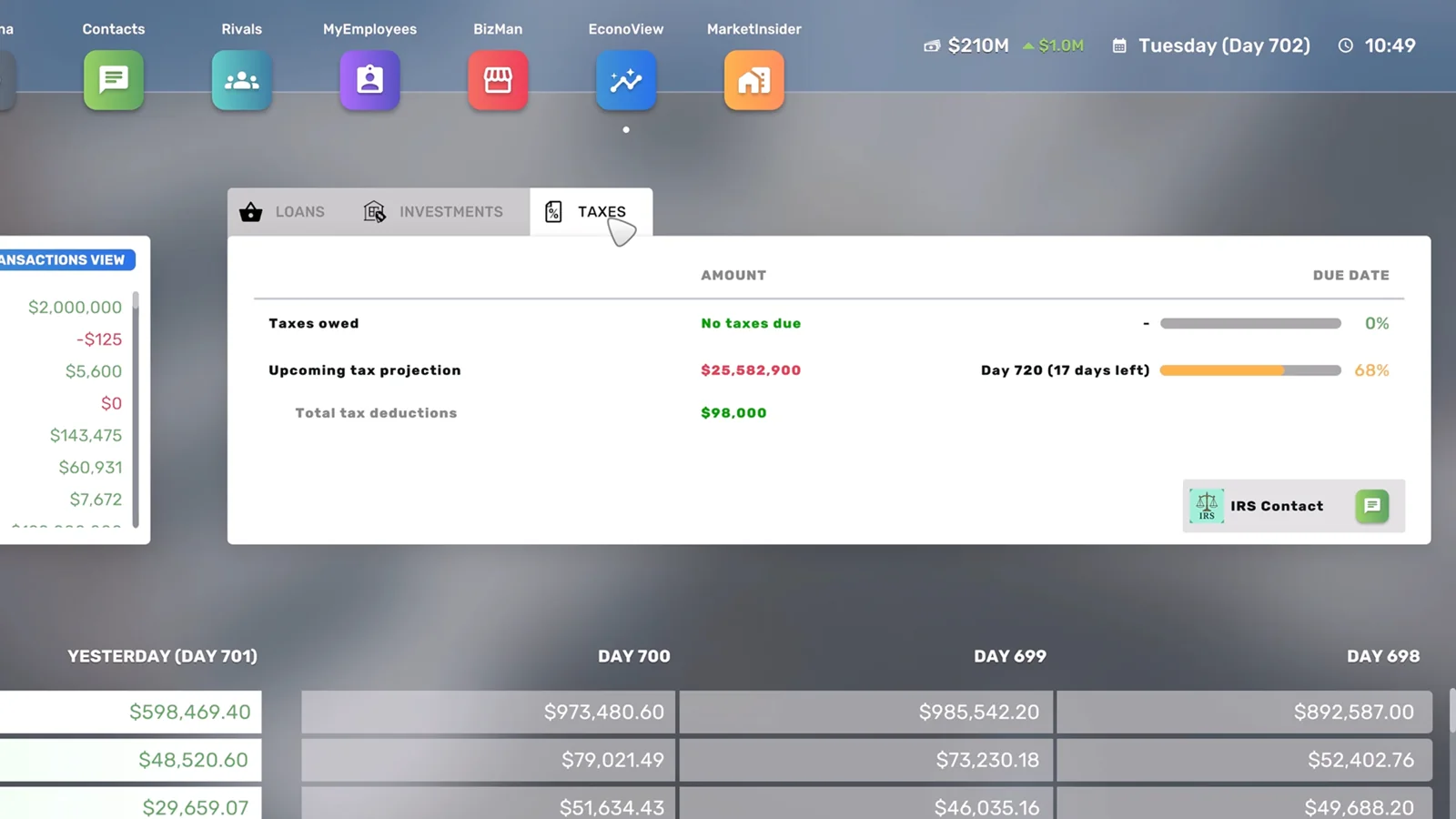
The official 1.0 release rebalanced taxes with more deductions intended to reward annual growth. It added a ten-percent late fee, partial tax payments, and an EconoView tax area showing current debt and an estimate for the next year. Build 3672 then fixed a projection that could display the wrong tax rate and an IRS contact that appeared too early. Any screenshot or test made before that correction is unsuitable for a current projection table.
The banking overhaul removed negative interest, added daily automatic investment, more detailed investment growth reporting, and partial withdrawals without closing the whole account. Older advice to invest solely to avoid a weekly cash penalty is obsolete. Investments now compete with cash reserves, debt repayment, property, and operating expansion on risk, liquidity, and expected value rather than on avoidance of negative interest.
Hovgaard has not published a complete 1.0 deduction schedule, investment return table, or guaranteed fund performance. Difficulty and custom settings affect tax rates and other economic values. Therefore use the rate, projected liability, fund history, and transaction results shown in the current save. This guide gives formulas and controlled tests, not a promise that a specific purchase erases a fixed percentage of tax or that a fund always earns a quoted return.
Action checklist
- Confirm Build 3674 or later.
- Advance one day after updating.
- Read the tax rate and projection in the save.
- Discard pre-3672 projection screenshots.
- Ignore old negative-interest tactics.
- Record difficulty and custom tax settings.
| Feature | 1.0 status | Planning consequence |
|---|---|---|
| More deductions | Released; full table unpublished | Measure projection changes |
| Ten-percent late fee | Released | Reserve and pay before lateness |
| Partial tax payment | Released | Reduce an unpaid balance when cash is tight |
| Negative interest | Removed | Cash reserve has no old weekly penalty |
| Auto-invest and partial withdrawal | Released | Separate long-term investing from liquidity |
Taxable result is not bank cash
Tax planning starts by separating operating profit, accounting deductions, and cash movements.
Sales bring cash and revenue together, but many other events separate them. Buying inventory reduces cash while creating stock; COGS is recognized when resources are sold or consumed. Buying equipment or property consumes cash and may affect deductions under the 1.0 system, but the exact treatment must be observed in EconoView. Borrowing adds cash without being sales revenue. Principal repayment removes cash without being an operating loss.
Use a planning bridge: estimated taxable base equals recognized taxable income minus deductions accepted by the game. Estimated tax equals taxable base times the displayed save-specific rate, subject to the game's own rounding and rules. Cash after tax equals opening cash plus operating cash flows plus financing and investment withdrawals minus purchases, capital spending, investment deposits, debt service, and tax paid. Never infer tax from the change in bank balance alone.
For example, a business earns two hundred thousand of operating profit but buys three hundred thousand of property and receives a two hundred fifty thousand loan. Cash might rise one hundred fifty thousand before other flows even though profit is only two hundred thousand. The tax projection may fall if the property is an eligible deduction, but the loan itself should not be called profit. Record each component and let the corrected EconoView projection reveal the game's treatment.
Action checklist
- Separate revenue from loan proceeds.
- Separate COGS from inventory purchase timing.
- Record capital purchases by date.
- Use the displayed tax rate.
- Reconcile projected tax before and after transactions.
- Do not derive tax from bank movement.
| Event | Cash | Operating profit | Projection test |
|---|---|---|---|
| Sale | Inflow | Revenue less recognized cost | Usually raises taxable result |
| Inventory purchase | Outflow | No duplicate immediate COGS | Observe timing |
| Loan proceeds | Inflow | Not business revenue | Should not be treated as sales |
| Property purchase | Outflow | Capital allocation | Measure 1.0 deduction effect |
| Investment deposit | Outflow/transfer | Not store expense | Check tax panel separately |
Read the EconoView tax panel
The projection is a live planning estimate, not an invoice frozen for the year.
Record three items: the tax rate displayed for the save, any amount currently owed, and the estimate for the next tax year. Add the game day and days remaining in the configured year. A growing business can make the estimate rise quickly because recent profitable days are replacing startup losses. A major eligible purchase can move it in the other direction. The number should be monitored after midnight and after material transactions.
Build 3672 fixed a wrong-rate projection. If the panel still appears inconsistent on 3674, first check difficulty, custom settings, date, and whether the figure is current debt or next-year estimate. Then reproduce on an unmodded save. The official F2 channel accepts save data but is one-way; link a Steam discussion if a response is needed.
Do not reserve only the projected amount. Forecast profit through year end, apply the displayed rate conservatively, and compare that forecast with the live estimate. A tax reserve can equal current amount owed plus projected liability through the payment date plus a buffer for faster growth. Update weekly and after opening a large business, changing factory exports, buying property, or closing a loss-making operation.
Action checklist
- Capture rate, current debt, and next-year estimate.
- Include game day and year length.
- Update after midnight.
- Forecast remaining-year profit.
- Add a growth buffer.
- Reproduce anomalies without mods before F2.
| Panel value | Meaning | Action |
|---|---|---|
| Tax rate | Save-specific percentage | Use instead of online tables |
| Currently owed | Existing liability | Prioritize before late fee |
| Next-year estimate | Live forecast | Reserve and sensitivity-test |
| Days remaining | Timing exposure | Plan cash conversion |
| Post-transaction change | Evidence of treatment | Log in deduction test |
Build a rolling tax reserve
Treat tax cash as unavailable for expansion even though it remains in the bank.
A simple reserve equals currently owed tax plus projected next-year tax plus a forecast adjustment. The adjustment can be expected remaining taxable profit times the displayed rate, minus profit already reflected in the projection, plus a safety buffer. Because the projection method is not fully published, compare this manual figure with EconoView rather than claiming mathematical identity.
Worked case: EconoView estimates one hundred eighty thousand, the company expects another four hundred thousand of taxable profit, and the displayed rate is fifteen percent. If only half of that future profit appears represented, add thirty thousand for the unreflected half and twenty thousand buffer. Reserve two hundred thirty thousand. This is an illustration; replace every input with the save's values.
Keep the reserve in cash now that negative interest is gone. An investment fund can decline at the payment date, and a property may take time to sell. If cash is temporarily insufficient, 1.0 allows partial tax payments. Paying what is available reduces exposure, but verify in the current interface how the remaining balance and fee are shown. Partial payment is a relief valve, not a reason to underreserve.
Action checklist
- Ring-fence currently owed tax.
- Add the projected next-year amount.
- Forecast profit not yet represented.
- Use the displayed rate only.
- Keep near-term tax reserve in cash.
- Review after every major profit change.
| Reserve component | Example | Reason |
|---|---|---|
| Live projection | 180,000 | Current panel evidence |
| Unreflected future profit | 30,000 | 400,000 x 50% x 15% |
| Growth buffer | 20,000 | Forecast error |
| Total reserve | 230,000 | Not expansion cash |
| Invested portion | 0 | Avoid market timing risk |
Late fees and partial-payment triage
The official ten-percent late fee makes prevention more valuable than speculative return seeking.
When the due date approaches, rank cash uses: preserve the minimum needed to keep profitable operations trading, make the tax payment, meet unavoidable debt service, and defer discretionary expansion. Compare the certain late fee with the uncertain profit from holding inventory, investments, or a new project. A guaranteed ten-percent penalty is usually a severe hurdle, but the game does not publish every timing detail, so inspect the amount due and deadline directly.
If full payment is impossible, use the new partial-payment option and record the remaining balance before and after midnight. Do not assume the fee applies only to the unpaid part or to the original bill without observing the current build. A controlled save test can settle this: save before the deadline, pay a known fraction, advance, record the fee and balance, then reload and compare with no payment.
Avoid asset seizure. An older developer reply confirms that prolonged nonpayment can lead the IRS to take assets, but old grace-period numbers may no longer apply after 1.0. Current guidance should therefore state the consequence without repeating a fixed countdown. Keep vehicles, warehouse shelves, and operating assets out of danger by paying or testing before the deadline rather than relying on Early Access timing.
Action checklist
- Read the actual due date.
- Freeze discretionary spending.
- Protect only essential operating cash.
- Make a partial payment if full payment is impossible.
- Record remaining debt and fee behavior.
- Do not rely on an old grace-period table.
| Cash use | Priority near deadline | Reason |
|---|---|---|
| Essential stock for profitable sales | High but bounded | Preserves cash engine |
| Tax currently owed | High | Avoids ten-percent late fee |
| Required loan payment | High | Prevents debt distress |
| New decoration | Low | No immediate survival value |
| New speculative investment | Lowest | Uncertain return cannot justify certain fee |
Deduction testing instead of deduction folklore
Because no complete official deduction table is public, identify eligible spending through controlled before-and-after tests.
Label a save with build, difficulty, game day, displayed tax rate, current projection, and all same-day income. Save immediately before one transaction. Buy one clearly identified asset or expense, advance until the tax panel updates, and record the new projection. Reload and repeat without the purchase. The difference between branches is the observed projection effect under those conditions.
Test categories separately: employee education, equipment, vehicles, interior work, business acquisition, property, factory machinery, inventory, marketing, and investment deposits. Do not combine categories in one day. Repeat on a second day or property before calling the result stable. A current 1.0 community thread reports property as deductible and recommends buying before the tax boundary, but that is a test lead rather than a complete official rule.
Calculate implied tax effect as baseline projection minus purchase-branch projection. Implied deduction estimate equals tax effect divided by the displayed tax rate, if the rate is nonzero. This may be distorted by projection forecasting, timing, rounding, or other income, so publish it as an observation. Never write 'spending one million saves one million in tax'; a deduction, if accepted, reduces a base rather than normally returning the entire purchase price.
Action checklist
- Save before one isolated purchase.
- Record rate and projection.
- Run a no-purchase control branch.
- Advance the same amount of time.
- Repeat the category twice.
- Publish conditions and uncertainty.
| Field | Control branch | Purchase branch |
|---|---|---|
| Build/difficulty | 3674 / same | 3674 / same |
| Opening projection | Record | Same saved value |
| Transaction | None | One named purchase |
| Advance | Same hours/days | Same hours/days |
| Closing projection | Record | Record |
| Difference | Baseline | Observed tax effect |
Investments after negative interest
The investment decision is now about portfolio purpose, risk, and liquidity rather than avoiding an idle-cash charge.
Assign every dollar to one of four jobs: near-term operating cash, tax and debt reserve, committed expansion, or long-term surplus. Only the last category belongs in a volatile investment fund. Daily auto-investing is useful for consistently sweeping a chosen surplus, but it can starve the next importer order if the amount ignores working-capital cycles.
Partial withdrawal lets the company raise cash without closing the entire position. That improves flexibility but does not eliminate market risk. The value available on the withdrawal day may be below deposits. Investment return equals ending market value plus withdrawals minus deposits divided by a time-weighted or simple capital base; for an everyday game sheet, track net contributions and gain separately rather than claiming a precise annualized return from a short period.
The original developer description said the funds were based on anonymized real-world funds with daily synchronized movement. That statement is historical design context, not a current guarantee that the same mapping or return ranges remain unchanged. Use only the detailed growth values displayed in 1.0. No player action is documented as changing a fund's market path.
Action checklist
- Fund reserves before investments.
- Invest only true long-term surplus.
- Set auto-invest below worst-cycle free cash.
- Track deposits separately from gains.
- Plan withdrawals before tax deadlines.
- Reject guaranteed-return claims.
| Cash bucket | Investment suitability | Reason |
|---|---|---|
| Seven-day operations | None | Must be available |
| Tax currently owed | None | Fixed deadline |
| Committed importer order | None | Required working capital |
| Unscheduled contingency | Low | Liquidity has value |
| Long-term surplus | Eligible | Can tolerate fluctuation |
Measure investment performance correctly
Account growth is not investment return when daily auto-investing continually adds new principal.
For each day record opening value, deposit, withdrawal, closing value, and net gain. A simple daily gain is closing value minus opening value minus deposits plus withdrawals. Daily return is that gain divided by capital exposed, using opening value plus a timing adjustment when deposits occur during the day. If timing is unclear, report gain dollars and avoid false precision.
Worked week: opening value one hundred thousand, seven daily deposits of five thousand, no withdrawals, closing value one hundred thirty-eight thousand. The account rose thirty-eight thousand, but thirty-five thousand came from contributions. Investment gain is three thousand, not thirty-eight thousand. A naive growth rate of thirty-eight percent is wrong. A rough simple gain on average exposed capital near one hundred seventeen thousand five hundred is about two and a half percent for the observed interval, not a promised annual rate.
Compare funds over the same dates and with the same contribution pattern. Record maximum drawdown as the largest fall from a prior peak. Compare the investment with holding cash, reducing loan principal, or funding a business using stressed expected cash flows. Debt interest avoided is more predictable; business return is controllable but operationally risky; fund return is market-driven. There is no universally best option.
Action checklist
- Log opening and closing fund value.
- Subtract deposits from apparent growth.
- Add withdrawals back when calculating gain.
- Compare identical date windows.
- Record drawdown and liquidity needs.
- Do not annualize a tiny sample as certainty.
| Week item | Amount | Treatment |
|---|---|---|
| Opening value | 100,000 | Starting capital |
| Deposits | 35,000 | New principal, not return |
| Withdrawals | 0 | None |
| Closing value | 138,000 | Ending market value |
| Investment gain | 3,000 | 138,000 - 100,000 - 35,000 |
Auto-invest amount and cash-flow guardrails
Automate only the minimum surplus expected after a conservative operating cycle.
Calculate safe daily auto-invest as the lower of average daily free cash flow and stressed daily free cash flow, minus a replenishment margin. Free cash flow here means operating cash after routine orders, payroll, rent, marketing, debt service, and tax accrual. If the stressed figure is negative, disable auto-invest until reserves recover.
Example: normal daily free cash flow is twelve thousand, but the worst comparable week averages five thousand. Upcoming supplier variability requires two thousand per day of extra margin. Safe auto-invest is at most three thousand. Setting twelve thousand would transfer the entire normal surplus and force withdrawals whenever a weak day occurs. Frequent forced withdrawals defeat the purpose and may crystallize a loss.
Audit weekly. Compare auto-invest deposits with actual gain, emergency withdrawals, missed purchases, and minimum cash. Lower the amount when a rival attacks, a factory ramp begins, taxes approach, or a large property offer is outstanding. Raise it only after the operating reserve remains above target for a complete cycle. Automation is a rule, not a substitute for forecasting.
Action checklist
- Calculate normal and stressed free cash flow.
- Subtract supplier variability.
- Disable automation if stress cash is negative.
- Review before tax and expansion dates.
- Track forced withdrawals.
- Increase only after a full stable cycle.
| Input | Example | Effect |
|---|---|---|
| Normal free cash | 12,000 | Upper bound only |
| Stressed free cash | 5,000 | Conservative base |
| Replenishment margin | 2,000 | Protected variation |
| Safe auto-invest | 3,000 | 5,000 - 2,000 |
| Emergency withdrawal frequency | Target zero | Signals amount is too high |
Tax-aware capital allocation
A deduction can improve timing, but it cannot rescue a bad asset or an underfunded operation.
Compare alternatives on after-tax cash and strategic value. For an equipment purchase, include incremental operating contribution, purchase cash, observed projection reduction, resale value, and implementation delay. For property, include rent saved, rental income, occupancy ramp, strategic control, sale liquidity, and observed deduction. For investments, include uncertain gain, drawdown, and liquidity. For debt repayment, include interest avoided and reduced cash flexibility.
Worked comparison: a two-hundred-thousand machine is expected to add twelve thousand contribution per day after ten setup days. A property costs two million, saves two thousand daily rent, earns one thousand rent at stabilized occupancy, and provides site control. An investment has no guaranteed return. A tax effect should be measured but kept separate. Even a large property deduction may not overcome years of low operating yield if the company needs productive capacity now.
Use net present thinking without pretending the game follows real-world tax law. Payback days equal net purchase cash after observed tax effect divided by daily incremental cash benefit. Stress the benefit and include ramp delay. Choose projects that remain solvent before the deduction arrives. Never spend solely to reduce taxes: if a one-dollar purchase reduces tax by only the displayed rate fraction, most of the dollar still leaves the company.
Action checklist
- Model after-tax cash, not tax alone.
- Include ramp and occupancy delay.
- Measure deduction in the current build.
- Stress daily benefit.
- Compare debt reduction and investment alternatives.
- Reject purchases that fail without tax savings.
| Option | Primary return | Main risk |
|---|---|---|
| Business equipment | Incremental contribution | Demand or utilization |
| Property | Rent saved, rent income, control | Low yield and slow occupancy |
| Investment fund | Market gain | Drawdown at withdrawal |
| Debt repayment | Interest avoided | Lost liquidity |
| Hold cash | Flexibility | Opportunity cost only; no negative interest |
Property purchase near the tax boundary
Timing matters because occupancy and tax effects do not necessarily begin on the same schedule.
A property bought for deduction must still be funded in cash. Before purchase, preserve the tax amount currently owed and enough operating cash for accepted orders. Record the projection immediately before and after the property transaction. Community 1.0 observations report property deductions, but official notes only promise more deductions generally, so the test is essential.
Rental pricing has a seven-day countdown before the new rent applies, according to an April 2026 developer reply. Occupancy then changes over time, with lower rent the primary driver and neighborhood factors also involved. Therefore a property bought just before tax year end may show a projection effect before it reaches stabilized rent. Do not use stabilized rental income to justify near-term tax liquidity.
Create a timeline: offer and purchase date, tax boundary, price-change effective date, expected occupancy observation dates, and earliest prudent sale date. Compare the tax projection branch with a control save. If buying the building would force a late tax balance, the ten-percent fee can overwhelm the benefit. The sequence must preserve solvency first, then optimize deductions.
Action checklist
- Keep current tax debt in cash.
- Save before the property purchase.
- Record projection changes.
- Allow seven days for rent changes.
- Observe occupancy after the price takes effect.
- Do not count stabilized rent as immediate cash.
| Date | Event | Financial reading |
|---|---|---|
| Day 0 | Save and buy property | Cash leaves; record projection |
| Day 0 | Set proposed rent | Countdown begins |
| Day 7 | New rent applies | Occupancy still adjusts over time |
| Tax date | Pay from protected cash | Avoid fee |
| Later review | Measure stabilized rent | Decide hold or sell |
Tax and investment sensitivity analysis
Stress rates, profit growth, deduction effect, market return, and withdrawal timing together.
Build a matrix with projected operating profit, displayed tax rate, observed deductions, fund return, and cash deadline. Tax estimate equals positive modeled taxable base times rate. Investment ending value equals opening investment plus deposits minus withdrawals plus modeled gain. Closing liquidity subtracts tax and operating commitments. Use zero or negative investment return in the downside rather than a guaranteed positive assumption.
Example: taxable profit one million, observed deduction two hundred thousand, and rate fifteen percent gives modeled tax one hundred twenty thousand. If the deduction proves half as effective, tax becomes one hundred thirty-five thousand. If profit grows twenty percent while deduction stays fixed, tax becomes one hundred fifty thousand. A fund holding the tax reserve that falls ten percent can create an additional shortfall even though the tax model is correct.
Define action thresholds. If projected tax exceeds cash reserve by more than one week's stressed free cash flow, stop auto-invest and discretionary purchases. If a fund drawdown would force late payment, withdraw the tax portion early. If a deduction purchase only works under the most optimistic tax effect and asset return, reject it. Re-run after each major business launch and property acquisition.
Action checklist
- Stress profit above forecast.
- Stress deduction below observation.
- Use zero and negative fund returns.
- Include withdrawal timing.
- Set a reserve shortfall trigger.
- Recalculate after major transactions.
| Case | Taxable profit | Deduction | Tax at 15% |
|---|---|---|---|
| Base | 1,000,000 | 200,000 | 120,000 |
| Half deduction | 1,000,000 | 100,000 | 135,000 |
| Profit +20% | 1,200,000 | 200,000 | 150,000 |
| No deduction | 1,000,000 | 0 | 150,000 |
| Note | - | - | Use save-specific rate |
Audit sheet and reproducible 1.0 tests
A combined ledger provides evidence for deductions, returns, partial payments, and liquidity decisions.
The daily sheet needs day, build, difficulty, opening cash, operating profit, inventory cash purchases, capital purchases by category, debt flows, tax projection, current tax owed, tax payments, investment opening value, deposits, withdrawals, market gain, closing value, and closing cash. Add notes for patches, rivals, outages, and mods. Use formulas rather than manually overwriting totals.
For deduction tests, branch one save into control and transaction cases. For late-fee tests, branch before the deadline and compare full, partial, and no payment, without risking the main save. For investments, use equal opening value and dates, then compare auto-invest with manual deposits while separating contributions from gains. Version every result as '1.0 Build 3674' and state all custom settings.
At each year end, archive the final projection, actual bill, deductions tested, fee if any, and payment date. Compare projection error with prior years. Update reserve policy rather than asserting that the game uses a fixed formula. If a test conflicts with official notes, reproduce unmodded and submit F2 with a linked discussion. This method remains useful after a patch because the same protocol can identify what changed.
Action checklist
- Log cash, projection, and investments daily.
- Name every capital category.
- Use control-save branches.
- Separate contributions from gains.
- Archive projection versus actual bill.
- Retest after every economic patch.
| Test | Control | Variant | Output |
|---|---|---|---|
| Deduction | No purchase | One purchase | Projection difference |
| Partial tax | No payment | Known partial payment | Remaining balance and fee |
| Auto-invest | No transfer | Fixed daily transfer | Cash and gain separation |
| Withdrawal | Hold fund | Known partial withdrawal | Value and cash timing |
| Patch comparison | 3674 save copy | Later build copy | Documented behavior change |
Year-end close, investment liquidation, and audit controls
A structured close converts the live projection into a funded payment and separates tax savings from wealth transfers.
Begin twenty game days before the boundary, or earlier when the configured year is short. Freeze a copy of the EconoView projection, current amount owed, displayed rate, cash, investment value, accepted orders, debt payments, and all planned capital purchases. Forecast each remaining day using conservative operating profit and cash timing. The close calendar should name the last safe date for an investment withdrawal, importer order, property offer, and optional expansion.
Reconcile profit to cash. Start with business operating profit, add back recognized COGS that was paid in earlier periods only for the cash bridge, subtract current inventory purchases, capital acquisitions, principal repayments, investment deposits, and tax payments, then add loans, asset sales, and investment withdrawals. This bridge does not change taxable profit; it explains why enough accounting profit can coexist with inadequate payment cash.
Prepare a deduction register. For every material purchase record category, item or address, amount, transaction day, projection immediately before, projection after the panel updates, displayed rate, control-save result, and confidence. Separate an official fact, such as the release adding more deductions, from an observed test, such as one property lowering one save's projection. Never merge several purchases and claim each caused the entire movement.
Prepare an investment liquidation ladder. Cash and near-term operating reserves are first. Funds intended for tax within the horizon are scheduled for partial withdrawal before the deadline. Long-term positions remain invested only when the remaining cash fully covers tax and operations. If two funds must be sold, compare current unrealized gain or loss, but do not delay a certain liability in pursuit of a recovery that the game does not guarantee.
Worked close: cash is three hundred thousand, current tax owed is one hundred thousand, next-year projection is two hundred twenty thousand, accepted orders are eighty thousand, and ten days of fixed obligations are seventy thousand. The minimum protected amount is four hundred seventy thousand before buffer, so the company has a one hundred seventy thousand shortfall. A fund worth five hundred thousand can supply that amount through partial withdrawal while leaving three hundred thirty thousand invested. A new two-hundred-thousand property purchase is not funded unless another source replaces its cash use.
Run sensitivity cases. If remaining profit is twenty percent above plan, recalculate tax at the displayed rate. If an expected deduction has only half the observed effect, increase the reserve. If an investment falls ten percent before withdrawal, test whether payment remains possible. If a rival attack lowers receipts, preserve tax and essential operations before marketing escalation. The close passes only when the combined downside avoids late fees without stopping profitable core stores.
After the payment, verify EconoView shows the correct remaining liability. Record partial payments separately and capture any fee. Do not assume the absence of an objective means a bill was paid when the panel says otherwise; Build 3672 corrected IRS timing, but a reproducible discrepancy still deserves an unmodded F2 report. Archive screenshots, save copy, and ledger totals so the next year starts from evidence.
Review performance after year end. Investment gain is ending value plus withdrawals minus deposits and opening value. Tax forecast error is actual bill minus the last pre-boundary projection, adjusted for transactions after that snapshot. Deduction test error compares the observed projected reduction with the actual bill difference when a clean comparison is possible. Use these errors to widen or narrow next year's reserve buffer rather than inventing a permanent rate table from one cycle.
Action checklist
- Start the close before the final cash cycle.
- Freeze projection, rate, and commitments.
- Maintain a transaction-level deduction register.
- Schedule partial investment withdrawals early.
- Run combined tax, market, and rival downside cases.
- Verify the remaining liability after payment.
- Archive the save and screenshots.
- Update next year's reserve buffer from forecast error.
| Close control | Evidence | Decision |
|---|---|---|
| Tax funding | Owed plus projection plus buffer | Ring-fence cash |
| Operating funding | Orders, payroll, rent, debt | Protect core cycle |
| Deduction register | Before, after, control branch | Accept only observed effect |
| Investment ladder | Value, gain, withdrawal date | Liquidate only required amount |
| Post-close audit | Actual bill and remaining balance | Recalibrate forecast |
Research ledger
These links establish mechanics or provide a reproducible lead. Any balance-sensitive number still has to be checked in the current save.
Questions answered
What is the current tax rate?
There is no single safe online answer. Read the rate shown in the Build 3674 save because difficulty and custom settings matter, and Build 3672 corrected the projection's displayed rate. Capture the rate, current amount owed, next-year estimate, game day, configured year length, and difficulty in the tax ledger. If a screenshot predates Build 3672, do not use its projected rate as evidence. Forecast remaining-year profit with the save's displayed rate, then compare that manual reserve with EconoView instead of claiming the two formulas are identical. Recheck after midnight and after major purchases, closures, factory export changes, or a converted-save update. If the panel remains inconsistent, disable mods, branch the save, advance the same period in a control, and submit the reproducible case through F2. The official notes guarantee the corrected display, partial payment, more deductions, and late fee; they do not supply one universal percentage for every mode.
Which purchases are deductible in 1.0?
Official notes confirm more deductions but do not publish a complete table. Current community testing reports property, but each category should be verified with a controlled before-and-after EconoView test. Save before one transaction, record the corrected projection, make only the named purchase, allow the panel to update, and compare with an identical no-purchase branch. Repeat for education, equipment, vehicles, interiors, property, machinery, inventory, marketing, and business acquisitions instead of combining them. Divide an observed projection reduction by the displayed rate only as an approximate implied deduction, because forecasting, timing, and rounding can interfere. A deduction reduces the modeled tax base; it does not make an unwanted asset free or guarantee a cash refund equal to its price.
Should I invest the tax reserve?
Usually no when payment is near. Partial withdrawal improves liquidity, but market value can fall. Keep deadline cash safe now that ordinary cash has no negative-interest charge. Treat the reserve as unavailable for daily auto-invest and reconcile it after every material projection change.
Does account growth equal investment return?
No. Subtract deposits and add withdrawals when calculating gain. Daily auto-investing can make an account grow even when the underlying investment loses value.
Can I pay part of the tax bill?
Yes, 1.0 officially added partial payments. Record the remaining liability and test current late-fee behavior rather than relying on Early Access grace-period claims. Before the deadline, duplicate the save and note the current bill, cash, due date, and build. In one branch pay a known fraction; in another make no payment; advance both through the same boundary and compare the remaining balance and fee. Keep the main save funded and do not risk essential assets merely to complete the experiment. If full payment is possible without stopping profitable operations, the certain ten-percent late fee makes delay difficult to justify. If it is not possible, protect the smallest stock and payroll cycle that generates cash, make the partial payment, stop auto-invest and optional capital spending, and forecast the remaining balance daily.